How to Stop a Dog From Chasing Cars
A pickup truck is not a squirrel, buddy.
A pickup truck is not a squirrel, buddy.
by Savannah Admire, | March 19, 2025
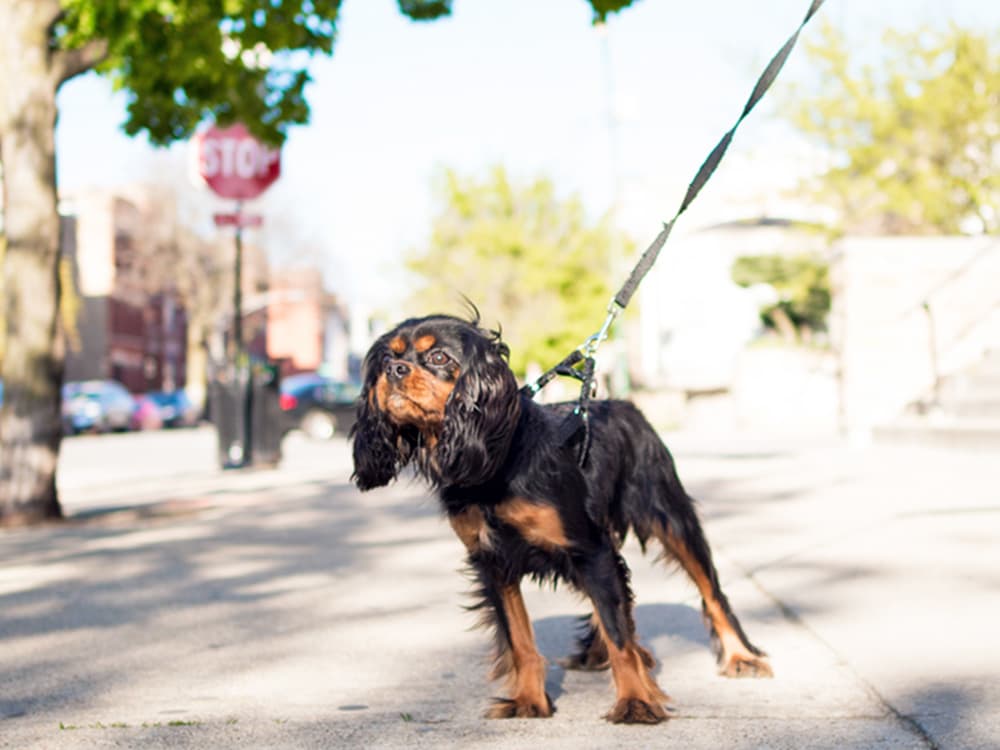
Page Light Studios / Shutterstock
Chasing cars isn’t just a classic Snow Patrol song (opens in a new tab) — it’s also a dog behavior that’s so common you can find it in cartoons and comic strips. But what may be funny in two dimensions can be deadly in reality, and you definitely don’t want your dog to get in the habit of pursuing your neighbor’s Subaru when they leave for work each day.
Keeping your dog safely inside or in the backyard is one option, but that urge to chase (opens in a new tab) won’t simply go away on its own. How can you stop your dog from trying to take a bite out of a sedan (and endangering their life in the process)?
Why do some dogs seem to lose their minds when a truck goes by?
If you see your dog chase a car — or attempt to — it can be easy to see the behavior as impulsive (opens in a new tab). But chasing is a natural dog behavior (opens in a new tab). Dogs have a natural prey chase drive (opens in a new tab) (also known as a predatory chase drive), which means they often feel the overwhelming urge (opens in a new tab) to chase … well, anything: other dogs, cats, birds, small animals, and, yes, cars.
“Chasing cars is a very natural behavior for a lot of dogs,” certified professional dog trainer and author Sassafras Patterdale (opens in a new tab) says.
The rapid movement of another animal or object in particular triggers dogs to chase; it’s like a reflex. “The sound and movement of moving cars, especially fast-moving cars, taps into a dog’s natural prey drive or, depending on the breed, herding drive,” Patterdal says.
Some breeds have been bred for hunting and pursuit, which means they may have higher prey drives than others and may make them more likely to go after a passing car. Other dogs want to chase because it’s simply fun and activates the pleasure centers in their brains. Others still are stressed by the sound and movement of cars, which they may respond to by engaging in chasing behaviors or lunging (opens in a new tab) at passing cars.
Even if their impulse to chase is natural, the last thing you want is your dog lunging at cars or, even worse, pulling away from you and giving chase. The result could be injury or even death to your pet, not to mention potential injury to you if your dog pulls you down or liability for collisions or accidents.
If you’re wondering how to stop a dog chasing cars, it’s important to start by keeping your distance from any traffic, no matter how slow, until you train your dog to react appropriately.
How far away should you and your dog be from traffic? That depends on your dog’s comfort level. Standing on the sidewalk may be plenty of distance for some pups, while others may need a little more space when training.
“Try to walk your dog at a distance where they are able to see cars but aren’t inspired to chase them,” Patterdale recommends. “If your dog is over-aroused by the moving vehicles, try to move farther away.”
Keeping your dog on a leash (opens in a new tab), preferably a short, six-foot lead, not a retractable or long-line one, is also important, according to Patterdale. “Safety is a first priority,” Patterdale says. “Dogs should be on leashes when out walking to prevent them from being able to access cars they are chasing.”
Make sure you also have a secure grip on the leash or use a wearable, hands-free option that tethers your dog to you.
Before you can teach your dog not to chase cars, you have to have the basics down. Work on the “stay” command until your dog understands to hold their position (opens in a new tab) until you release them. You can also teach your dog “watch me (opens in a new tab),” which encourages them to focus on you and ignore their surroundings. It’s also essential to practice and trust in your dog’s recall (opens in a new tab) so you know they’ll come when called, even in exciting situations.
“It’s important to understand why our dogs are chasing cars and that it’s natural for dogs,” Patterdale says. “We want to focus on creating opportunities for them to be successful.”
To teach your dog chase is not for cars, regularly practice rewarding their attention with cars in sight, either with a treat or a clicker if you prefer clicker training (opens in a new tab).
“When your dog sees a car, praise and treat them,” Patterdale says. “This can help to shift your dog’s emotional response to the moving vehicles.”
When your pup consistently looks at you rather than a passing car, slowly begin to decrease the distance between your dog and the traffic. Creating this positive association around cars is known as counterconditioning — using positive reinforcement (opens in a new tab) training to help your dog learn new behaviors.

For some dogs, it’s not as simple as just throwing a ball.
Keeping your dog physically and mentally stimulated can also help reduce your dog’s prey drive. Consider interactive toys that tap into your pup’s natural hunting and chasing instincts and educational toys (opens in a new tab), such as puzzles that engage your dog’s brain. If you have a dog with prey drive, the right toys can simulate hunting without putting your pet in danger.
Another thing you can do is provide your pet with plenty of exercise (opens in a new tab), with or without the use of toys. Toys that help facilitate games of fetch (opens in a new tab) or tug of war, playing fetch (opens in a new tab) without a toy, or even organized dog sports, such as herding trials, provide opportunities for play (opens in a new tab) that are healthier and safer alternatives to pursuing vehicles.
If your dog keeps chasing after cars (or trying to) even after you’ve worked consistently on training, you may want to enlist the help of a professional dog behaviorist. A specialist may be able to help determine issues or breed traits that could cause your dog’s chasing behavior.
“Animal Safety Tips.” Veterinary Hospital, hospital.cvm.ncsu.edu/resources/animal-safety-tips (opens in a new tab). Accessed 4 Mar. 2025.
“The Basics of Training Your Dog.” Leader Guide, book, pub. No. 4H436, WISCONSIN 4-H, pp.1-3. 4h.extension.wisc.edu/files/2021/05/The-Basics-of-Training-Your-Dog.pdf (opens in a new tab)
“Clicker Training - Positive Reinforcement.” http://extension.purdue/edu/news/county/bartholomew/2020/06/documents/4-H-Dog-lessonsbooklet-1-9-pdf (opens in a new tab). Accessed 4 Mar. 2025.
Feng, Lynna C., et al. “How Clicker Training Works: Comparing Reinforcing, Marking, and Bridging Hypotheses.” Applied Animal Behaviour Science, vol. 181, May 2016, pp. 34-40. https://doi.org/10.1016/j.applanim.2016.05.012 (opens in a new tab).
“Impulsivity as a Behavioural Trait in Dogs (2024-04-10).” Canine Cognition and Human Interaction Lab | Nebraska. 10 Apr. 2024, dogcog.unl.edu/blog/impulsivity-behavioral-trait-dogs-2024-04-10 (opens in a new tab).
Shabelansky, Anastasia, and Seana Dowling-Guyer. “Characteristics of Excitable Dog Behavior Based on Owners’ Report from a Self-Selected Study.” Animals, vol. 6, no. 3, 15 Mar. 2016, p. 22, https://doi.org/10.3390/ani6030022 (opens in a new tab).
“Training ‘Stay’ vs. ‘Wait.’” Cornell University College of Veterinary Medicine, www.vet.cornell.edu/departments-centers-and-institutes/riney-canine-health-center/canine-health-information/training-stay-vs-wait (opens in a new tab). Accessed 4 March 2025.
Turner, Roxanne. “Tricks and Tips to Keep Dog Training Fun and INteresting for Both the Handler and the Dog - Part 1.” MSU Extension, 12 Mar. 2013, www.canr.msu.edu/news/tricks_and_tips_to_keep_dog_training_fun_and_interesting_for_both_the_handl (opens in a new tab).
Savannah Admire is a writer and pet mom to two dogs and a cat. Under the name Savannah Cooper, she has published poetry in 40 different publications, as well as a poetry book, Mother Viper (2025). When she’s not writing, you can find her reading, taking photos, or volunteering as a content creator for her local community theatre. As a pets writer, she focuses on cat and dog behavior and pet parenthood. She currently lives in Western Maryland.
Behavior & Training
Behavior & Training
Lifestyle
Behavior & Training
Why regular exercise can mean a less destructive dog and a happier you.
Lifestyle
And why you shouldn’t skip the longer routes.
Behavior & Training
Even a mild-mannered dog can turn into a wild thing when feeling trapped.