Is My Cat Angry at Me? How to Tell if Your Cat is Upset
Cat behaviorist Kristiina Wilson on how to tell if your cat is grumpy—or just kind of like that.
Cat behaviorist Kristiina Wilson on how to tell if your cat is grumpy—or just kind of like that.
by Sio Hornbuckle, expert review by Kristiina Wilson, MA, CCBC | December 13, 2024

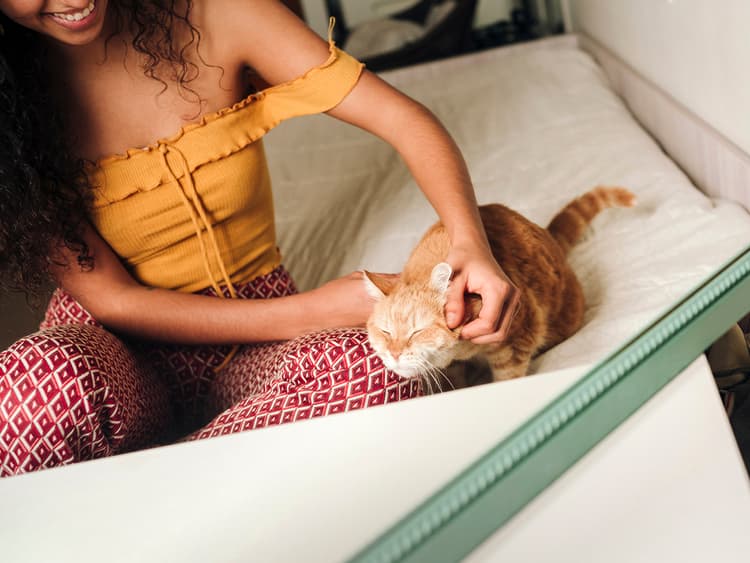
Photo: Helena Lopes / Pexels
Let’s face it: Cats can be kind of (really) grumpy. In their defense, they’re usually annoyed for totally valid reasons — loud sounds, unwanted physical contact, dirty bathrooms, etc. — that’d ruin any human’s mood, too. But it isn’t always just “cattitude.” Studies show that feline behavioral concerns, particularly aggression, are one of the most common reasons for veterinary visits.
What’s more, unless you’re Sabrina the Teenage Witch, your cat probably isn’t speaking English to let you know what they’re thinking. That’s why it’s important for pet parents to learn how to interpret their animal’s body language to understand what they’re trying to tell us — and when it’s more than just a bad mood.
Cats are known for their strong personal boundaries, so how do you know when your cat’s aloofness crosses into negative feelings that should be addressed? Although it can be difficult to discern your pet’s inner world, understanding feline emotions can lead to a better bond with your cat. Here are some important tips.
While some scoff at pet parents who anthropomorphize their pets, or attribute traditionally human emotions to the animals in their lives, studies show emotional health is key when it comes to pets’ medical treatment and overall happiness.
“Understanding emotions is at the heart of veterinary behavioural medicine and is key to preventing, managing and treating reported behavioral problems in domestic cats,” a 2018 study says.
That same study said in veterinary or scientific contexts, the “emotions” of cats are defined not as “feelings” like humans would have, but as instinctual motivations — or involuntary reactions to certain environmental stimuli. In other words, science may not have proven that your cat can feel angry, but they can certainly act angry.
Because we cannot, unfortunately, speak with our beloved pets, we must rely on behavioral cues and body language to discern whether our cats are angry or distressed. Here are some of the key indicators.
Piloerection is when a cat’s hair stands straight up — you’ve probably seen this depicted in Halloween illustrations of jumping black cats. “When a cat does that, they are always, always either surprised or upset in some way,” cat behaviorist Kristiina Wilson says. “They’re trying to make themself bigger. If you see a cat doing that, be careful around that cat, or see what’s going on that’s upsetting them.”
The first and most common sign a cat is upset is a hiss, or, less frequently, a growl. Cats hiss for a number of reasons, but primarily fear, being startled, or being overstimulated. Regardless of the reasoning, these vocalizations indicate discomfort in cats and should be noted carefully.
Chronic hissing and growling can be related to poor socialization in cats, according to a study published in iScience in 2022. But if your cat is not normally afraid of humans or hissing, when they do, note what environmental factors could be contributing to this new stress.
One of the most important clues about a cat’s mood is their tail. “A really happy cat who’s excited and happy to see you will have a tail up with a little bend in the tail,” Wilson says. “A cat who’s upset or fearful will have their tail down or tucked underneath their legs.”
You also want to keep an eye on the movement of a cat’s tail. “Every cat is different,” Wilson reminds us. “But for the most part, cats will use rapid movement at the tail — especially the tail tip — to indicate aggravation or irritation. A slow wave of the tail is usually happiness.” A thumping tail can mean that a cat is annoyed.
Wilson notes that tail positions and their meanings mean pretty much the same thing in both dogs and cats. So, checking a cat’s tail is a good jumping-off point for people who are more used to dog body language.
Similarly to tail position, ear position is pretty standard when it comes to both dogs and cats. “Ears that are pointed up are positive,” Wilson says. “Ears that go back are angry, and when they’re down and back, they’re fearful.”
Like piloerection, an arched back is a recognizable Halloween posture. “The classic Halloween cat is a fearful cat, unfortunately,” Wilson says. “It’s a freaked-out cat.” A cat with an arched back is trying to appear larger, which is a sign that they might feel threatened.
While vocalizations and physical movements may be the most obvious way to tell when your cat is upset, if you want a more subtle (and often earlier-onset) sign that they are distressed, look into their eyes. Pupil dilation has been used by scientists in studies to track when cats feel fear, and is an important sign to watch.
Some people find it shocking, but the truth is that a purring cat isn’t always a happy one. Purring is often an indication of relaxation, but “purring can also be used to self-soothe when a cat is in pain or when they’re very unhappy,” Wilson says. “You really want to monitor if something else is going on that's the reason they’re purring. You could have a cat who’s in physical distress.”
Once you’ve determined your cat is angry or distressed, it’s time to get to the bottom of why this is happening. There are a number of common triggers for feline anger or stress.
Change is hard, especially for cats, who often love their routines as much as we love them. Cats can have anxiety set off by big shifts, like a move or a new pet or child, or even something as small as rearranging the house. Identify if there have been any changes to the environment, or the people in it, to determine if that is the root of your cat’s bad mood.
If your cat’s anger seems abrupt or out of character, it’s important to take them to the veterinarian for a check up. Cats will often act out in anger when they are experiencing physical pain. Health issues and environmental changes can often be connected. Many cats even experience feline interstitial cystitis (FIC), a chronic pain syndrome in domestic cats that simulates a urinary tract infection brought on by external stressors.
Similar to environmental changes, alterations to feeding or playtimes can disturb sensitive cats. If you’ve been working late recently and missing your cat’s nightly meal time, consider slowly shifting the schedule, or getting an automatic feeder.
Now you’ve determined your cat is upset and maybe even pinpointed the cause. But it’s important to keep these tips in mind in the heat of the moment.
The best way to approach a cat when they are angry is to not approach it at all, at least momentarily. Pet parents should be sure to let their cat calm down in a quiet area before attempting to get to the heart of why they are acting out.
It’s natural to want to keep an eye on your cat when they are upset, but don’t stare too hard. Experts say staring can be perceived as a threat to cats. If you do make eye contact, be sure to do some long, slow blinks to encourage the cat to feel safe.
Speaking softly and calmly can help reassure an upset cat, especially if the cat is familiar with you. One study shows that cats respond positively to being spoken to in a baby voice, so give it a try.
The best treatment for an angry cat is prevention. Once you’ve identified potential reasons your cat is angry, try these tips to avoid situations that might cause distress or anger in cats.
Routine is very important to the emotional wellbeing of cats — both regular playtime, and feeding times. Experts recommend you feed your cat two to three times at the same hours each day. If getting on a consistent schedule is difficult for you, give an automatic feeder a try.
If you cannot avoid a big change for your cat, focus on easing transitions for a more peaceful experience for all involved. When moving house, be sure to leave your cat’s environment as stable as possible until absolutely necessary, and consider relocating them out of the house on the actual day of the move. When bringing a new pet home, introduce them slowly and deliberately to the resident cat. Patience is always key to keeping your cat happy with big changes.
Regular playtime can reduce stress and strengthen the bond between you and your cat, so whether you think your cat is “angry” with you or not, make sure to schedule in some time to play each day. Many interactive toys can keep your cat entertained while you are away.
Everyone gets angry sometimes, including your cat, but there are some situations that warrant consultation with a veterinarian or behaviorist.
If your cat is experiencing ongoing, unexplained aggression, it may indicate underlying health issues or more deeply rooted behavioral issues that warrant a behaviorist or other experts. Rule out any health concerns with a check-up at the vet, and get a recommendation for a behaviorist if needed.
In most cases, experts advise to try addressing your cat’s unease by improving environmental factors. However, experts recommend in high-risk scenarios to seek help immediately. Such high-risk situations include if there are children or elderly people in the home, family members with physical and/or mental health problems, and cat parents who are actively afraid of the cat.
Amat, Marta, and Xavier Manteca. “Common feline problem behaviours: Owner-directed aggression.” Journal of Feline Medicine and Surgery, vol. 21, no. 3, 25 Feb. 2019, pp. 245–255, https://doi.org/10.1177/1098612x19831206.
“Communi-Cat-Ive: Cats Attentive to Owner’s Voice, Research Finds.” The Guardian, Guardian News and Media, 25 Oct. 2022, www.theguardian.com/lifeandstyle/2022/oct/25/communi-cat-ive-cats-attentive-to-owners-voice-research-finds.
“Feline Behavior Problems: Aggression.” Cornell University College of Veterinary Medicine, https://www.vet.cornell.edu/departments-centers-and-institutes/cornell-feline-health-center/health-information/feline-health-topics/feline-behavior-problems-aggression. Accessed 12 Dec. 2024.
Griffin, Francesca C, et al. “Evaluation of clinical examination location on stress in cats: A randomized crossover trial.” Journal of Feline Medicine and Surgery, vol. 23, no. 4, 15 Oct. 2020, pp. 364–369, https://doi.org/10.1177/1098612x20959046.
Mikkola, Salla, et al. “Fearfulness associates with problematic behaviors and poor socialization in cats.” iScience, vol. 25, no. 10, Oct. 2022, p. 105265, https://doi.org/10.1016/j.isci.2022.105265.
Mouzon, Charlotte de, et al. “How’s My Kitty? Acoustic Parameters of Cat-Directed Speech in Human-Cat Interactions.” Behavioural Processes, vol. 203, Nov. 2022, p. 104755, https://doi.org/10.1016/j.beproc.2022.104755. Accessed 26 Mar. 2023.
Stella, Judi, et al. “Effects of stressors on the behavior and physiology of Domestic Cats.” Applied Animal Behaviour Science, vol. 143, no. 2–4, Jan. 2013, pp. 157–163, https://doi.org/10.1016/j.applanim.2012.10.014.
Tateo, Alessandra, et al. “Factors influencing stress and fear-related behaviour of cats during veterinary examinations.” Italian Journal of Animal Science, vol. 20, no. 1, 1 Jan. 2021, pp. 46–58, https://doi.org/10.1080/1828051x.2020.1870175.
Sio Hornbuckle specializes in pet news, animal science, and pop culture. They live in New York City with their cat, Toni Collette.