Should Your Puppy Be Chewing on Bones?
A vet’s guide to which age you can give your puppy a bone — and how to keep them safe as they chew on them.
A vet’s guide to which age you can give your puppy a bone — and how to keep them safe as they chew on them.
by Emily Johnson, expert review by Dr. Chris Konvalinka, DVM | September 8, 2026

PeopleImages / iStock
Bones and puppies seem like a classic combo, but if you’re wondering if bones are actually safe for them, you’re not alone. Although bones can be a boredom breaker and help clean your puppy’s teeth as they chew, they also come with risks, many of which outweigh the pros. We explore the safest options and alternatives that can give your pup the same benefits without the risks.
Whether you’re raising a velociraptor (aka a teething puppy) or an occasional nibbler, there’s a lot to consider before adding bones to their diet. Below, veterinarians Dr. Chris Konvalinka, Dr. Kevin Puzycki, and Dr. Joanna Herberger answer common questions about puppy chew bones and share the dos and don’ts of feeding bones to puppies.
Stilyana Stankova / iStock
First things first: You may have heard that you shouldn’t give your puppy bones. But why? Are chew bones bad for puppies?
This depends on the type of bone, Puzycki explains. “For bones that can be ingested, it’s crucial to note the potential complications, including the risk of choking, digestive obstruction, or other injuries. In general, due to those risks, bones that can be broken down and ingested are not recommended.”
In many ways, bones pose more risks than benefits for puppies. Herberger details some potential hazards if your puppy gets ahold of a bone.
Choking: If a puppy swallows a small bone by accident, it can get lodged in their throat. This is a medical emergency that requires immediate vet care.
Broken teeth: Puppy teeth are much more prone to breaking than adult teeth, especially when chewing on something hard, like a bone.
Other mouth injuries: Bones that splinter or have sharp edges can also easily cut a puppy’s gums, tongue, or roof of their mouth.
GI upset: Many bones can be fatty and high in protein, which can be hard on a puppy’s stomach and cause issues like vomiting, diarrhea, or constipation.
Digestive blockages: If a puppy eats a full bone or too many bone pieces, they can get stuck in their intestinal tract, causing a blockage. This requires emergency surgery.
In short, avoid giving your puppy actual bones, and stick with non-edible bones. That means rubber chew toys and other faux bones are the safest option. (Read this guide to learn more about safe options for your puppy after they’re all grown up.)
“Cooked bones are more brittle than raw bones, and they are more likely to splinter and cause injuries,” Herberger explains. During the cooking process, bones lose their nutrients and become thin and brittle, meaning they can easily shatter if your puppy gets a good chomp.
“Feeding puppies cooked chicken bones is not recommended, as bones can pose serious risks to their health,” Puzycki says. “Cooked bones, especially those that are brittle, can splinter and cause choking hazards or lead to blockages in the gastrointestinal tract. Emergency surgery may be required to address these issues, making it essential to avoid giving any type of cooked bones to puppies.”
Raw bones are safer for puppies to gnaw on, but Herberger warns that they still pose risks. Because of how hard raw bones can be, they can easily break a puppy’s teeth if they chew too hard.

When those little razors start biting, keep these tips in mind.
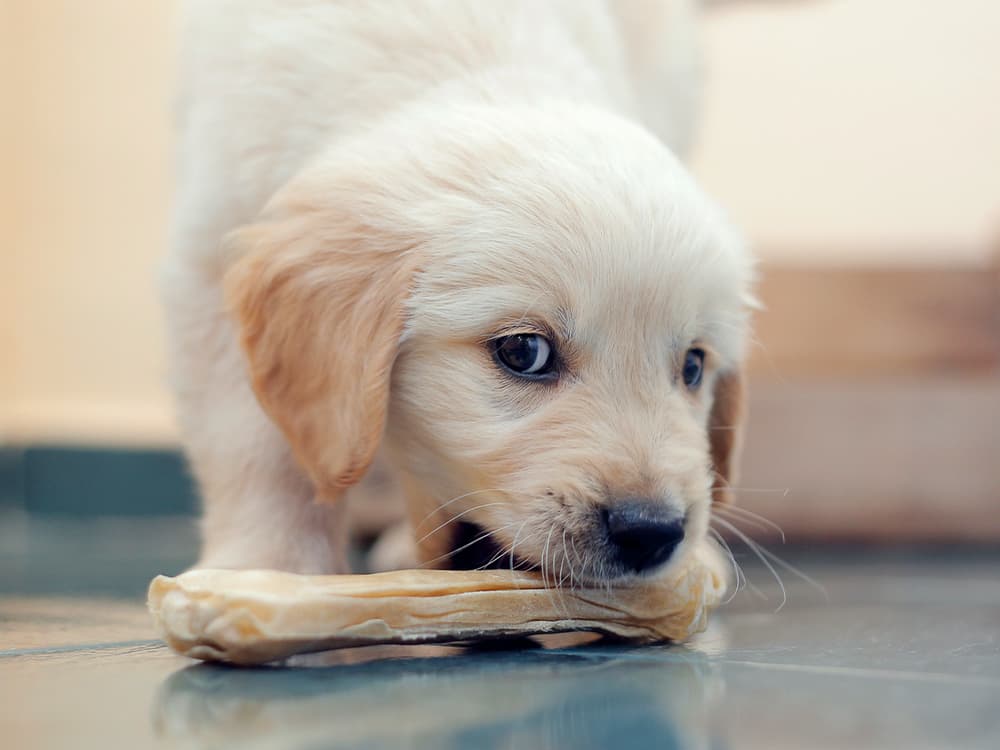
So what counts as an actual bone to avoid? Many people wonder if they can give their puppies beef bones and other types of natural bones. Can puppies chew on rawhide bones? No. Can puppies chew on marrow bones? No. What are the best rawhide bones for puppies? None. What are the best marrow bones for puppies? None. Again, the answer to these questions is no, no, none, and none. (Some people even ask if puppies can chew on antler bones. Again, no.)
While bones aren’t the best choice for puppies, there are some that are more dangerous than others. “In general, the smaller poultry bones could be more harmful if they splinter into smaller, sharp pieces,” Konvalinka says. Those small pieces can damage your puppy’s mouth or be easily swallowed and cause problems internally.
While not a traditional bone, puppy parents should also be wary of feeding them rawhide bones. Rawhide comes with a plethora of risks (containing toxins, not easily digestible, choking hazard, and so on) that outweigh the benefit of cleaning your dog’s teeth as they chew on them.
Dogs are natural chewers, and this especially goes for puppies who are teething. Gnawing on something (other than your hands) can relieve some of the pain as they lose their baby teeth. Chews can offer several benefits for puppies.
“Chewing on bones provides puppies with a natural outlet for their chewing instincts, promoting mental stimulation and preventing boredom. Safe chewing can also help maintain good oral hygiene by reducing plaque and tartar buildup, contributing to healthier teeth and gums,” Puzycki says. “Puppies go through teething, and safe chew toys can provide relief by soothing sore gums and providing a satisfying chewing experience.”
Chewing also gives your puppy something to do when they get bored. The act of chewing keeps their mind busy and is a great way to calm anxious pups. Bones and toys — ones made specifically for puppies — are better options than letting your puppy find other things to chew on, like your expensive running shoes.

Two words: Endless entertainment.
If you decide the benefits of bones are worth it for your puppy, there are a few things to keep in mind. Herberger says it’s crucial to choose appropriately sized raw bones to prevent your puppy from choking or swallowing any pieces. Knuckle bones are better options because there aren’t any holes for their jaws to get stuck in, and they don’t break into pieces as easily. She also advises limiting their chewing time — short sessions as a treat versus regularly — and supervising them at all times.
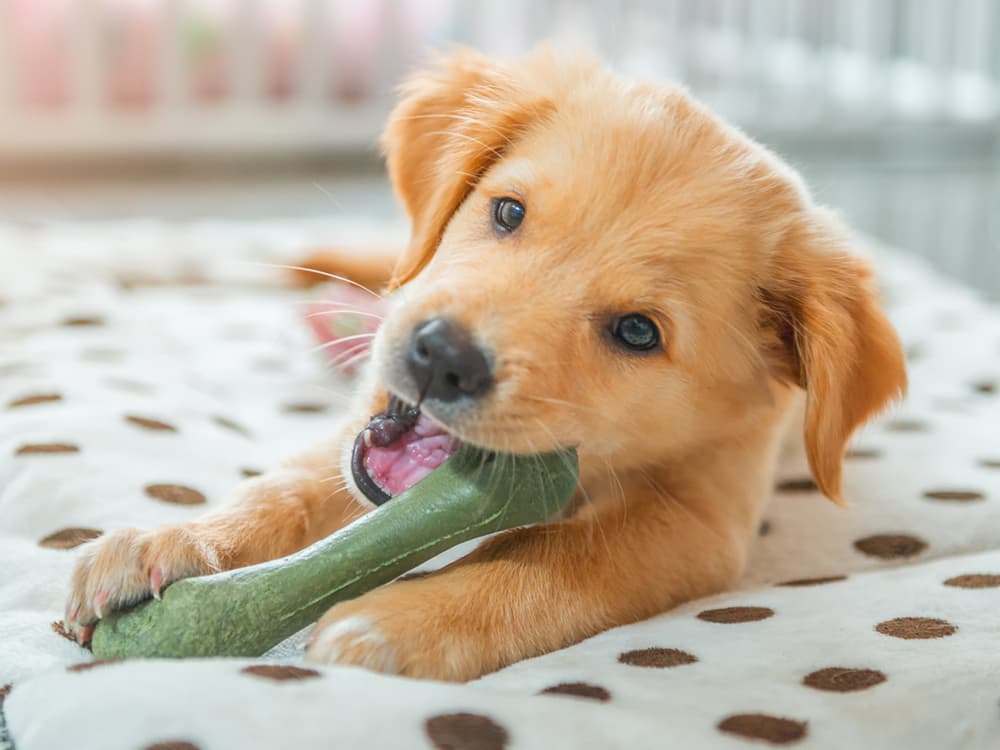
Instead of giving your puppy a bone, there are plenty of safe alternatives on the market. Rubber chew toys, nylon bones, natural chews (like pig ears), and other puppy-specific chew toys are better options, whether your pup is teething or not. These aren’t hard enough to damage your pup’s mouth and aren’t meant to be swallowed.
“The safest chew bones for puppies are those explicitly labeled for chewers and are designed to resist breaking down or being easily ingested,” Puzycki says. A good test is watching how a chew holds up once your puppy actually gets to it. “It’s crucial to avoid items that can splinter or break apart easily, as these pose a choking hazard or could lead to digestive issues if ingested,” Puzycki says.
Soft for the mouth: Choose a puppy chew bone that’s soft enough to be satisfying to gnaw on, but not so soft that it might come apart.
Durable material: Opt for items such as rubber chew toys, nylon bones, or other durable materials.
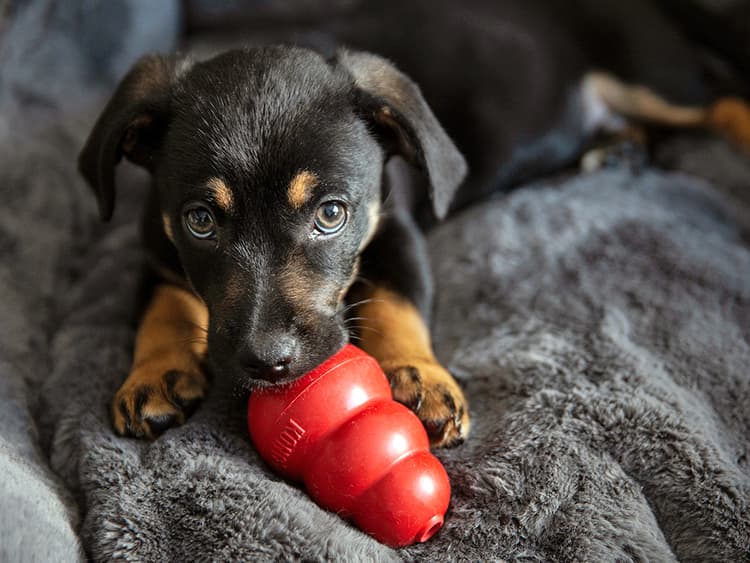
Frozen chews are excellent: Frozen dog toys, such as a frozen Kong, are great choices for a teething puppy. Fill it with plain yogurt or canned puppy food, and freeze it overnight to make it last longer.
“If you have concerns or questions about the most suitable chew toys for your specific puppy, consult with your veterinarian for personalized recommendations based on your puppy’s breed, size, and chewing habits.”
The best thing you can do for your pup in an emergency is to identify critical symptoms and know where they can be treated.
Puppies can choke on bones if they are small enough. If you can see the bone in your puppy’s throat, you can try to remove it using your fingers, Herberger says. If the bone is invisible, you can perform the Heimlich maneuver for dogs. Always call your vet no matter what. And if you can’t help your dog, get immediate care.
According to Konvalinka, senior partner at Bahama Road Veterinary Hospital, it’s best to wait until puppies have a full set of adult teeth before giving them any real bones. “We see the baby teeth break fairly often when puppies are chewing on things even less sturdy than bones.”
Bones don’t necessarily have added nutritional benefit, Konvalinka explains, especially when your dog is already eating a high-quality, complete puppy formula kibble. Puppies have very specific nutritional needs, and adding bones — especially fatty marrow bones — into the equation could actually do more harm than good.
Dogs’ digestive systems are well-equipped to dissolve bones, Konvalinka says, but there are still risks of undigested pieces accumulating and forming a blockage. But this applies to a fully grown, adult dog. Puppies have much smaller, more sensitive stomachs, making it more likely for them to suffer from GI upset or experience a blockage. Although some puppies may be able to handle small bones, their GI tracts aren’t fully or properly developed enough to digest most bones.
“Bully sticks are a popular chew option for dogs, but I don’t recommend them [for puppies],” Puzycki says. “It’s important to supervise pets while they’re chewing on a bully stick to ensure they don’t ingest large pieces that could pose a choking hazard or lead to digestive issues.” Instead, he recommends Solid Gold’s Air Dried selections.
Canine Welfare Science. Accessed September 7, 2026. https://caninewelfare.centers.purdue.edu/health/nutrition/puppies.
How to ‘Chews’ the Best Dog Chew Toys. Texas A&M University Veterinary Medicine & Biomedical SciencesJuly 25, 2019. https://vetmed.tamu.edu/news/pet-talk/how-to-chews-the-best-dog-chew-toys.
Pinto CFD, Lehr W, Pignone VN, Chain CP, Trevizan L. Evaluation of teeth injuries in Beagle dogs caused by autoclaved beef bones used as a chewing item to remove dental calculus. , ed.Loor JJPLOS ONE2020;15(2):e0228146. doi:10.1371/journal.pone.0228146. https://journals.plos.org/plosone/article?id=10.1371/journal.pone.0228146.
Re-evaluating your dog’s diet. Cornell University College of Veterinary Medicine2026. Accessed September 7, 2026. https://www.vet.cornell.edu/departments-centers-and-institutes/riney-canine-health-center/canine-health-topics/re-evaluating-your-dogs-diet.
Williams K, Downing R. Feeding growing puppies. VCA Animal Hospitals 2023. Accessed September 7, 2026. https://vcahospitals.com/know-your-pet/feeding-growing-puppies.

Emily Johnson is a long-time pet writer and animal lover, working with brands like PetMD, Chewy, Whisker, Great Pet Care, Rover, GoodRX, and more on topics including pet health, training, overall ownership tips, and pet insurance. You can typically find Emily with a cat in her lap and a Diet Coke in hand, exploring the outdoors with her pup, or tending to her jungle of indoor plants. At home, she has a dog (Goose), two cats (Zoey and Nugget), and a horse (Dewey).

Pet Wellness
Pet Wellness
Behavior & Training

Nutrition
They do like to use those chompers, but is this a safe alternative to your fingers?
Pet Wellness
Dr. Shea Cox warns pet parents about the unexpected dangers of dog bones.
Pet Wellness
Here are four common dental problems your pup might face and how to treat them.
Nutrition
It isn’t just a healthy cocktail for the likes of Gwyneth Paltrow and Kylie Jenner. And we’ve got a recipe.

Pet Wellness
They’re very cute, but they can also face a number of health problems.
Behavior & Training
If your dog tries to scarf down literally everything in sight, you need this advice.