Duke’s Puppy Kindergarten Is Training the Next Generation of Service Dogs
At Duke’s Canine Cognition Center, puppies sleep in dorms, go to class, and help researchers figure out which dogs are built for the job.
At Duke’s Canine Cognition Center, puppies sleep in dorms, go to class, and help researchers figure out which dogs are built for the job.
by Dahlia Ghabour, | August 18, 2026
Duke Canine Cognition Center
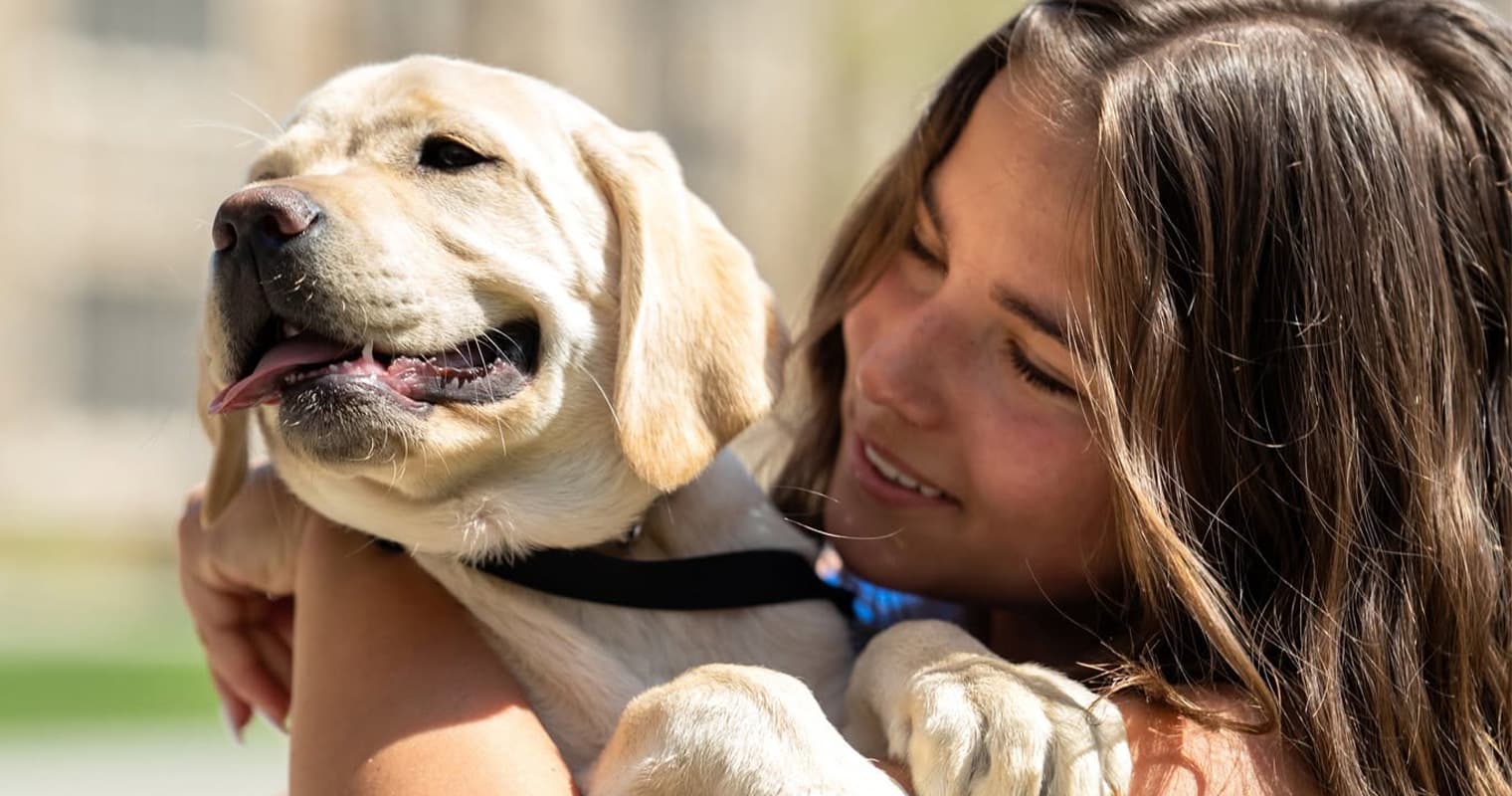
On any given day at Duke University, you might spot a puppy sleeping under a lecture hall seat, navigating a crowded dining hall, or trotting across a quad full of students. But these puppies are not pets — they’re future service dogs who are in Puppy Kindergarten.
Across all service-dog training programs, more than half of the canine candidates never make it through the rigorous training and graduate to become service dogs. As a result, there’s a persistent shortage of working dogs and a long waitlist for the people who need them.
Duke University’s Puppy Kindergarten program at the Canine Cognition Center tackles this problem by studying early development training strategies for puppies so that, eventually, more dogs graduate. This will increase the supply of service dogs.
“It takes $50,000 and two years to raise and train each service dog, which is why supply is super short,” research scientist and program director Vanessa Woods says. “Part of our mission is to figure out if we can predict with an amount of certainty, at 10 or 12 weeks old, if a puppy is going to make it through school.”

Mariah Jones / Duke Canine Cognition Center
Duke Puppy Kindergarten was founded at the Canine Cognition Center at Duke University in 2018. (About 10 percent of the Duke student body applied to volunteer during the program’s pilot phase.)
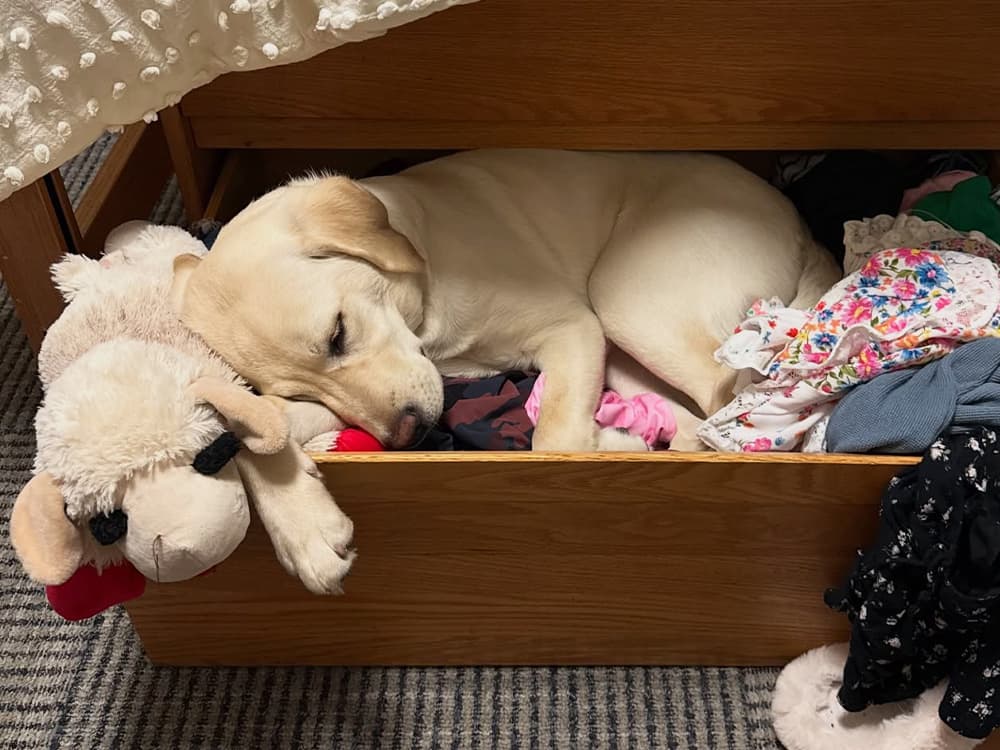
The puppies spend their first weeks at Duke learning the foundations they’ll need for a successful career. They sleep in college dorms, go to class, and basically call the campus their home, all while contributing to research on canine cognition, behavior, and development.
The Puppy Kindergarten program has drawn national attention and was even featured in the 2024 Netflix documentary Inside the Mind of the Dog.

Most dorms do not allow pets. But there are some exceptions.
Researchers continue to study how a puppy’s early cognitive abilities and temperament relate to later success, with the goal of better understanding which traits help different service dogs succeed.
Woods says the theory is that early exposure to training makes the puppies more successful. By partnering them with students, the puppies can meet different kinds of people and engage with all the rich, stimulating environments on the college campus.
“There’s not much research on the best way to raise a dog, especially a dog who is going to have such an important job,” Woods says. “We know with children that if they get exposed to a lot of different people early on, they become more tolerant, and in some cases, more cooperative. So we want to expose the puppies to all the love on Duke’s campus, with lots of different puppy-raisers, to see if that makes a difference in their success.”
The results are starting to back that up. “So far, there are early indicators that Duke puppies are more confident than puppies raised in a puppy-raising family,” Woods says. “Not that those dogs aren’t confident, but something about the amount of exposure [our puppies] get impacts them.”
The program was originally funded by the National Institutes of Health (NIH) and has partnered with several service dog organizations over the years, including Canine Companions.
But when the NIH grant funding ran out, Duke students weren’t ready to let go. “We didn’t have the funding for about three semesters. There were no puppies, and everybody was very upset,” Shelby Carter, who went on to become Duke Puppy Club’s president, tells CBS 17.
“We had lots of sad students wandering the hallways just looking for the puppies,” Woods says. “They said, ‘We’ll do anything to get the puppies back.’ We said, 'We’re happy to run it, but you guys have got to do everything — come up with the structure, organize the volunteers, raise all the money.’ And they did.”
What they built is the Duke Puppy Club, a student-led, student-funded organization that keeps the program alive on campus through volunteers.
“Before, it was a research project,” Paige Stevens, one of the club’s founders, tells CBS 17. “Now it’s just for the love of puppies, and because we want to raise service dogs for people who need them.”
Today, Puppy Kindergarten is supported by Duke Puppy Club and works with the North Carolina nonprofit Eyes Ears Nose & Paws (EENP) to prepare future service dogs for advanced training. “It’s a beautiful ecosystem, and I’m happy to be a part of it,” Woods says.
Duke Canine Cognition Center
The puppies from Eyes Ears Nose & Paws begin the first part of their training when they’re eight weeks old. If a Duke semester lines up with the beginning of a litter’s training, they are placed with Duke students. If not, they work with community volunteers.
During those first weeks, the puppies go everywhere the students go: to class, campus events, and sometimes even sleep in dorm rooms overnight. Graduate student Leah McNutt takes her puppy, Doug, to physical therapy classes, where he naps on treatment tables and gets used to crutches, canes, and walkers. “He’s exposed to a lot of people very often,” she tells CBS 17. “He’s getting a lot of exposure just in my program alone.”
“The Duke trainers basically do puppy socialization on steroids,” EENP Executive Director Maria Ikenberry says. “They are really hitting it hard. There are week-by-week focuses, with topics like spending time alone without freaking out to being comfortable in a crate. Puppies have to meet other dogs, children, cats, work in public places — and the Duke students are a great way for the puppies to meet so many people.”
From midnight bottle feedings to months of rehabilitation, the innovative WISKR program proves healing can happen in unexpected places.
Puppy Kindergarten trainers work with the puppies until they are six to nine months old and deemed ready for the second stage of their training, working with inmates at North Carolina Prisons as part of a program called At Both Ends of the Leash (ABEL).
The puppies typically train in prison for about a year before they are ready to be matched with a client, Ikenberry says.
Ikenberry says the prison section of the dogs’ training includes lots of body-position training, practical skills a service dog needs to be useful:
Jumping on or off surfaces
Using their nose to push buttons
Picking up objects and taking them to a handler
Tugging on a rope to open a door
“Learning to back up is an interesting one,” Ikenberry says. “It’s not intuitive for the dogs, but it’s really helpful. If someone’s in a wheelchair, a dog can go in front first. It’s also helpful for positioning, telling a dog to back up to get to the right area to pick something up.”
EENP works exclusively with Labrador–Golden Retriever mixes. As with many organizations, they struggled to find volunteers with enough time commitment to train service dogs.
However, as co-founder Deb Cunningham points out, incarcerated people have a lot of time, and not a lot of ways to spend it. The program offers a win-win scenario for both incarcerated people and service dogs.
From 2014 to 2024, ABEL trained 59 service dogs and placed them in jobs with people with disabilities. (According to the EENP website, the organization has placed 101 total dogs with clients since 2010.)
“A lot of the trainers enter the program not really being able to picture themselves as people who help other people,” Ikenberry says. “It’s a foreign concept to see themselves as agents of positive change in the world. This program provides a structured opportunity to reframe how they see themselves and understand they really are able to do a lot of good in the world.”
Ikenberry says that unlike some other prison training programs, EENP can connect deeply with trainers due to the organization’s proximity. The program includes public speaking, training to communicate effectively with others, and personal development for the trainers.
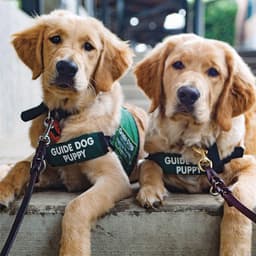
A volunteer with Guide Dogs for the Blind shares her experience.
You don’t need to be a college student to become a volunteer. Many service dog programs, including EENP, have an ongoing need for volunteers in many different areas.
Interested volunteers can apply online by filling out a simple form with their contact and housing information, similar to a dog adoption form. Volunteer puppy trainers at EENP must be able to do the following:
Come to weekly one-hour classes
Get your puppy to vet appointments
Drop your puppy off and pick them up from EENP three days a week
Commit to keeping a puppy for a minimum of four months
Duke students can get involved with the Puppy Club by contacting current club leaders on their website. There are many service-dog organizations across the country in need of volunteers, so if you’re interested in becoming a volunteer puppy trainer, search for one in your area and submit an application.
“I wish more people understood how much it takes to raise and train a service dog,” Woods says. “What we’re asking them to do is really extraordinary. They can get meds, carry bags, and turn on lights. We have technology that can do some things, but dogs can get you a drink, find your keys — things that would take someone with a disability 30 minutes to do. It’s life-changing what these dogs can do.”
Although you might think the terms are interchangeable, there is a big difference between a service dog, therapy dog, and emotional support dog.
Service dogs are trained to perform specific behaviors to assist someone with their disability. Service dogs are protected under the Americans With Disabilities Act and have “public access rights.” This means they are legally allowed into public places such as stores, theaters, and airports, even if there is a no-pets policy.
Therapy dogs are certified to provide comfort in settings such as hospitals, therapy offices, schools, and prisons. They do not have public access rights and are not protected under the ADA, so they can’t go places where pet dogs aren’t allowed.
Emotional Support animals are pets who provide comfort and support to their parents with mental-health conditions. These animals are prescribed by mental health professionals when necessary. They are not protected by the ADA and do not have public access rights, so they can’t go places where pet dogs aren’t allowed.
Dogs from working breeds can be service dogs. The most common ones are Labrador Retrievers, German Shepherds, Golden Retrievers, and Poodles.
Working service dogs are trained to support people with disabilities in many different ways, such as guide dogs for blind or low-vision people, mobility-assistance dogs, sensory- or allergy-detection dogs, and medical- or psychiatric-alert dogs.
Duke Puppy Kindergarten Admits Seven New Students | Duke Today. (2019, September 11). Duke Today. https://today.duke.edu/2019/09/duke-puppy-kindergarten-admits-seven-new-students
Duke Puppy Kindergarten | Department of Evolutionary Anthropology. (n.d.). In evolutionaryanthropology.duke.edu. Retrieved July 23, 2026, from https://evolutionaryanthropology.duke.edu/duke-puppy-kindergarten
Newland, M. (2026, March 24). Duke students save Puppy Kindergarten, where service dogs get their start. CBS17.Com. https://www.cbs17.com/news/local-news/durham-county-news/duke-students-save-puppy-kindergarten-where-service-dogs-get-their-start
Our mission – Puppy Club at Duke. (2026). Duke.Edu. https://sites.duke.edu/dukepuppyclub/our-mission

Dahlia Ghabour is a Louisville, Kentucky-based freelance writer with award-winning work featured in newspapers such as the Louisville Courier-Journal and the Jacksonville Business Journal, both online and in print. Dahlia has two gray cats, a love of wildlife and zoo conservation, and a deep desire to one day pet a cheetah.
Lifestyle

Adoption Advice
Lifestyle
Lifestyle
Guide dogs, mobility support, medical alert, PTSD service dogs... here’s who they are and what they do.
Lifestyle
Both are perfect angels, to be clear.
Lifestyle
Trained service dogs can sense panic attacks, wake veterans from nightmares, and give all the healing cuddles.
Lifestyle
Loyal, devoted, and dutiful, Pit Bulls are proving to be pretty well suited to helping humans in need.
Behavior & Training
At airports, hospitals, schools, and more, therapy dogs make things better.

Lifestyle
A behaviorist’s take on what the Netflix documentary gets right (and a couple things it gets wrong).