What Does Blood in Your Cat’s Stool Mean? Find Out if You Should See a Vet
Anytime you see blood, it’s concerning. But the good news is that it isn’t always as scary as it seems.
Anytime you see blood, it’s concerning. But the good news is that it isn’t always as scary as it seems.
by Dr. Shelby Neely, DVM, expert review by Dr. Heidi Cooley, DVM CHPV CCXP | February 27, 2025
Santi Nuñez / Stocksy
Blood is a scary thing to see. If it’s a scrape on your knee, it’s one thing. But if it’s internal, it’s easy to get alarmed.
A bit of blood in your cat’s stool is not always an emergency. Sometimes, the underlying cause can be anal gland irritation, hemorrhoids, or stress. However, in more troubling cases, where it’s persistent or accompanied by other symptoms, this can indicate that your cat is ill.
As a cat parent, it’s essential to learn about the difference between the two, so you know when it’s time for your cat to see their vet.
There can be differences in the appearance of the blood, depending on where it comes from in the intestinal tract. Bright red blood, known as hematochezia, tends to come from low in the intestines, such as the anus, rectum, or colon. Dark and tarry blood is digested blood, known as melena, and comes from higher in the intestinal tract, such as the small intestines.
No, blood in your cat’s stool is not normal. You should never ignore it. If it happens one or two times and is only a minimal amount, this could be a temporary reaction to a dietary change or mild intestinal upset. However, if it persists or is heavy, you must talk to your veterinarian.
Since you can’t see the inside of your cat’s intestinal tract, you won’t know if it’s serious. Seriousness depends on the underlying cause. If it only happens once or twice and the bleeding is a minimal amount, this is probably not an emergency.
However, if bleeding persists or is heavy, you should consult your veterinarian, especially if other symptoms accompany it. Watch for such signs as vomiting, diarrhea, or lethargy. Persistent or heavy bleeding, along with those symptoms, can mean something more serious, such as infections, parasites, or even cancer.
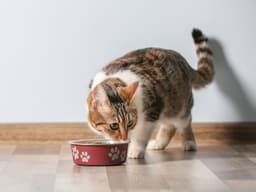
Dr. Bruce Kornreich explains why going this route isn’t always the answer.
Several conditions can lead to blood in a cat’s stool:
Sudden food changes, food intolerances, or allergies
Worms such as hookworms or protozoal infections
Salmonella, feline leukemia virus (FeLV), or panleukopenia
Chronic inflammation of the intestines.
Hard stools
Ingesting non-food items
Growths in the gastrointestinal tract
Hemorrhagic gastroenteritis (a sudden, severe condition requiring urgent care)
These are all conditions that require your pet to be seen by a veterinarian.

It’s not a pretty problem to have, but it’s important to know how to treat this condition.
There are several things a vet can do to try and find the cause of the blood, including:
A physical exam
A fecal examination
Blood tests
X-rays or an ultrasound
An endoscopy or a biopsy
You can’t treat a disorder until you know the underlying cause. The results of the vet exam and any testing will hopefully determine the underlying cause, so treatment can begin. Treatment can include the following.
Dietary adjustments: switching to a hypoallergenic or fiber-rich diet
Deworming medication: if parasites are detected
Antibiotics or probiotics: for bacterial infections or gut health
Anti-inflammatory drugs: to manage IBD or colitis
Fluid therapy: if dehydration is present
Surgery: in cases of tumors, blockages, or severe damage
Most conditions can be treated. And be assured that there are far more treatable issues than non-treatable conditions causing blood in your cat’s stool.
If your cat has no other symptoms and is acting normally, you should be able to wait and monitor their condition over the next day or so. If the blood continues or their condition gets worse, see your vet.
Yes, absolutely. Hookworms, whipworms, and roundworms can irritate the intestinal lining of your cat and cause bleeding. Fortunately, that’s an easy condition to fix. A fecal exam and some deworming medication will do the trick.
Yes, stress can contribute to colitis, leading to blood or mucus in the stool. Stress-induced colitis is often temporary, but a vet should evaluate your cat if their symptoms persist.
Yes, sudden dietary changes can upset your cat’s digestive system, leading to diarrhea, inflammation, and sometimes minor bleeding. If you change your cat’s food, you should do it slowly, transitioning over as much as a week.
While blood in your cat’s stool can be scary, it can usually be treated easily.
Persistent blood or heavy bleeding may require more diagnostic tests and more complicated treatment.
Monitoring your cat’s litter box is essential for catching abnormalities as soon as they occur.
Marks, Stanley L, and Michael D Willard. “Diarrhea in Kittens.” Elsevier EBooks, 1 Jan. 2006, pp. 133–143, pmc.ncbi.nlm.nih.gov/articles/PMC7149963, https://doi.org/10.1016/b0-72-160423-4/50018-4.
Matz, ME, and WG Guilford. “Laboratory Procedures for the Diagnosis of Gastrointestinal Tract Diseases of Dogs and Cats.” New Zealand Veterinary Journal, vol. 51, no. 6, Dec. 2003, pp. 292–301, https://doi.org/10.1080/00480169.2003.36383.
Dr. Shelby Neely is a freelance writer and veterinarian who graduated from the University of Pennsylvania School of Veterinary Medicine and has practiced veterinary medicine for 30 years, specializing in small animals. Her work has appeared in Allivet, AsktheCatDoctor, WhiskerDocs, Ask the Cat Doctor Radio, Ask the Cat Doctor TV, and numerous other websites, brochures, newsletters, newspapers, and ebooks. In her spare time, Dr. Neely likes to spend time with her three children, two grandchildren, three cats, two grand-cats, and five grand-dogs.
Nutrition
Pet Wellness
Nutrition
Pet Wellness
Gross? Yes. Important to discuss? Also, yes.