How Old Is My Dog in Human Years? Here’s a Dog Age Chart
Forget the “seven-year rule.” Here’s how dogs really age.
Forget the “seven-year rule.” Here’s how dogs really age.
by Katie Koschalk, | August 28, 2025

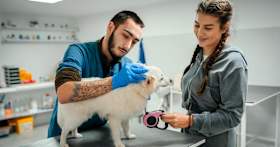
Ezequiel Giménez / Stocksy
You’ve probably heard the saying that one dog year equals seven human years, but that’s not exactly accurate. Dogs mature quickly in their early years, reaching adulthood in just a couple of years, and then their aging process slows.
Size plays a big role in how fast your dog ages, too. Larger breeds (opens in a new tab) age more quickly than smaller ones (opens in a new tab), meaning a Chihuahua (opens in a new tab) and a Saint Bernard (opens in a new tab) of the same age can be at very different life stages. Simply put, there’s no universal, one-size-fits-all formula.
So, how can you really determine your dog’s age in human years? We’re here to help. Read on to learn how dogs age, explore a detailed age chart, and discover how to estimate your dog’s age based on physical and behavioral clues.
Viewing your dog’s age through the lens of human years can help you better understand what they need, such as more playtime, extra joint care, or more frequent vet checkups (opens in a new tab).
There’s no exact formula for converting dog years to human years, but once a dog gets about two years old (opens in a new tab), these are the general guidelines.
Small dogs: 1 human year = 4 dog years
Medium dogs: 1 human year = 4 to 5 dog years
Large dogs: 1 human year = 5 to 6 dog years
Giant dogs: 1 human year = 7 to 8 dog years
The chart below shows how this plays out across different dog sizes and ages (opens in a new tab).
Dog’s age | Small (less than 20 pounds) | Medium (21 to 50 pounds) | Large (51 to 100 pounds) | Giant (100+ pounds) |
|---|---|---|---|---|
Human years | Human years | Human years | Human years | |
1 | 15 | 15 | 15 | 12 |
2 | 24 | 24 | 24 | 22 |
3 | 28 | 28 | 28 | 31 |
4 | 32 | 32 | 32 | 38 |
5 | 36 | 36 | 36 | 45 |
6 | 40 | 42 | 45 | 49 |
7 | 44 | 47 | 50 | 56 |
8 | 48 | 51 | 55 | 64 |
9 | 52 | 56 | 61 | 71 |
10 | 56 | 60 | 66 | 79 |
11 | 60 | 65 | 72 | 86 |
12 | 64 | 69 | 77 | 93 |
13 | 68 | 74 | 82 | 100 |
14 | 72 | 78 | 88 | 107 |
15 | 76 | 83 | 93 | 114 |
16 | 80 | 87 | 99 | 121 |

Wondering how old your dog is? We can help! Here’s how you can determine your dog’s age.
If you’ve adopted a dog (opens in a new tab) with an unknown background or aren’t sure exactly how old your pup is, you’re in luck. Veterinarians can often estimate a dog’s age based on physical and behavioral signs. While these indicators can’t tell you exactly how old your dog is, they can give you a general idea of which life stage your dog is in.
Here are some key clues that can help estimate a dog’s age (opens in a new tab).
Teeth: Puppies have all their baby teeth by five to six weeks old and their adult teeth by six months. As dogs get older, signs such as tartar buildup, gum disease, and worn or missing teeth can suggest their age.
Muscle condition: Young dogs typically have strong, defined muscles. Muscle loss, especially around the hind legs or shoulders, may indicate a senior dog (opens in a new tab).
Coat and skin health: A soft, shiny coat is often seen in younger dogs, while graying, thinning, or coarse fur can point to aging. Older dogs may also have dry skin or more lumps and bumps.
Energy level: High energy (opens in a new tab) and playfulness are common in puppies and young adults. Slowing down, sleeping more, or being less interested in play are often signs of aging.
Eyes: Clear eyes usually suggest youth. A bluish haze (nuclear sclerosis), cloudiness, or signs of vision loss can indicate that a dog is middle-aged or older.
Hearing and response: A slower response to sound or commands may signal hearing loss (opens in a new tab), which is common in senior dogs.
Behavior and cognitive function: Disorientation, pacing, disrupted sleep, or changes in behavior may be signs of cognitive decline in older dogs.
The average lifespan of a dog is typically 10 to 13 years, but studies show (opens in a new tab) a dog’s life expectancy can vary dramatically depending on several factors.
One of the main factors is size. Smaller dogs tend to live longer than larger dogs (opens in a new tab), often by several years. To get a better sense of the range, here’s how lifespan typically breaks down by size category.
Small dogs (such as Chihuahuas (opens in a new tab) or Toy Poodles (opens in a new tab)): 15 to 18 years or more
Medium dogs (such as Cocker Spaniels (opens in a new tab) or Beagles (opens in a new tab)): 10 to 14 years
Large dogs (such as Golden Retrievers (opens in a new tab) or Labradors (opens in a new tab)): 9 to 12 years
Giant dogs (such as Great Danes (opens in a new tab) or Mastiffs (opens in a new tab)): 6 to 10 years
Of course, size is just one piece of the puzzle. A variety of other factors (opens in a new tab) also play a role in how long a dog might live.
Genetics: Dogs with a strong genetic predisposition (opens in a new tab) to certain health issues may have shorter lifespans.
Nutrition and exercise: A balanced diet, regular exercise, and maintaining a healthy weight can support a longer, healthier life.
Preventive care: Routine vet visits, dental care, and vaccinations help catch and prevent issues.
Spaying-neutering: Research suggests (opens in a new tab) that spayed or neutered dogs (opens in a new tab) may live longer than those who are not.

Regular vet visits are key to keeping your pet healthy. Here’s what happens during a checkup, when to get them, and what to bring.
Dogs are generally considered seniors (opens in a new tab) when they reach the final 25 percent of their expected lifespan. Here’s a rough guide.
Small breeds: 9 to 11 years old
Medium breeds: 8 to 10 years old
Large breeds: 7 to 9 years old
Giant breeds: 6 to 7 years old
Most dogs reach their full height and weight between 12 and 18 months (opens in a new tab), but this varies by breed and size. Small breeds often finish growing by six to eight months, while large and giant breeds may continue growing up to 18 months of age.
Mixed-breed dogs tend to have fewer inherited health issues (opens in a new tab) than some purebred dogs, which may contribute to a longer average lifespan. However, lifestyle, care, and size still play a big role.
Keeping your dog at a healthy weight, feeding them a high-quality diet, providing regular exercise, staying up-to-date on vet visits and dental care, and offering plenty of mental stimulation and love — all contribute to a longer, healthier life.
AKC Staff. “A Timeline of Puppy Teething.” American Kennel Club, 3 May 2019, www.akc.org/expert-advice/puppy-information/timeline-of-puppy-teething (opens in a new tab).
AKC Staff. “Your Dog’s Age in Human Years: A Conversion Chart.” American Kennel Club, www.akc.org/expert-advice/health/how-to-calculate-dog-years-to-human-years (opens in a new tab).
Coates, Jennifer. “How Old Is My Dog in Human Years? Calculating Dog Years to Human Years.” PetMD, 13 Dec. 2024, www.petmd.com/dog/general-health/how-old-is-my-dog-in-human-years (opens in a new tab).
Hoffman, Jessica M., et al. “Reproductive Capability Is Associated with Lifespan and Cause of Death in Companion Dogs.” PLoS ONE, vol. 8, no. 4, 17 Apr. 2013, p. e61082, journals.plos.org/plosone/article?id=10.1371/journal.pone.0061082 (opens in a new tab), doi.org/10.1371/journal.pone.0061082 (opens in a new tab).
Paretts, Susan. “When Does My Puppy Finish Growing? How Long Do Puppies Grow?” American Kennel Club, 5 June 2025, www.akc.org/expert-advice/health/when-does-my-puppy-finish-growing (opens in a new tab).
Teng, Kendy Tzu-yun, et al. “Life Tables of Annual Life Expectancy and Mortality for Companion Dogs in the United Kingdom.” Scientific Reports, vol. 12, no. 1, 28 Apr. 2022, p. 6415, www.nature.com/articles/s41598-022-10341-6 (opens in a new tab), doi.org/10.1038/s41598-022-10341-6 (opens in a new tab).

Katie Koschalk is a freelance writer based in Northern California. Fusing her love and knowledge of animals with her journalism degree and years of professional writing, Katie is dedicated to improving the lives of pets and their caretakers by sharing helpful and accurate information. When she’s not at her desk, you can find her exploring trails with her Aussie, Hunter, cooking plant-based meals, and talking to her two cats, Jax and Sadie, in really ridiculous voices.

Breed Info

Adoption Advice

Breed Info
Adoption Advice
Pet parenthood can be tough, but finding the right vet doesn’t need to be. These tips will help you find the right vet for your pup.

Pet Wellness
Yes, you need to vaccinate your dog. Consider this your guide to their must-have vaccines, the optional ones, as well as vaccine schedules.

Pet Wellness
Spoiler: It’s a core vaccine. Here’s why it’s considered very important in keeping your dog healthy.

Pet Wellness
Also, learn about a step-by-step way to peacefully introduce them to toothbrushing as a way to maintain their health.

Behavior & Training
Because the pros of neutering your pup far outweigh any cons, especially when it comes to their behavior.

Adoption Advice
If your pet’s medical information seems confusing, you’re not alone. Here is how to better understand their records, so you can make sure your pet gets the care they need.