Do You Need to Clip Cat Nails? Yes—Here’s How Often and How to Do It
Trimming your cat’s nails doesn’t have to be a whole, dramatic thing. Here’s how to actually make it happen without losing a finger.
Trimming your cat’s nails doesn’t have to be a whole, dramatic thing. Here’s how to actually make it happen without losing a finger.
by Dr. Maria Zayas, DVM, | July 6, 2026
bombermoon / iStock
All cats will need a nail trim at some point in their lives. Although young cats might just be balls of pointy chaos you’re trying to manage, senior cats often develop nails that can grow into their paw pads and harm them.
Long nails can break and bleed, get caught on clothing and furniture, or hurt other pets, children, and seniors. For a domesticated species like cats, maintenance tasks such as nail trims and grooming keep them at their happiest and most comfortable. The trick, of course, is convincing them that this is true. Here’s what you need to know about cat nail trims.
Generally, you should trim your cat’s nails about every two to four weeks. It takes two weeks for the nails to become sharp again and protrude enough to feel — and up to a month to grow back to their full, standard length.
Cats with arthritis in their paws (usually seniors) may not use scratching surfaces often enough and with enough strength to exfoliate the outer layers of their nails. This causes them to start growing thicker, and they can curl into the paw pad instead of maintaining a normal nail shape. You usually don’t need to be strict about how often you trim your cat’s nails unless they are growing as described above, in which case they really need a nail trim about once a month to avoid problems.
Providing your cat with more scratching surfaces in a variety of orientations and made from different materials, along with a chat with your vet about options for supporting your cat’s joint health, can help your cat with issues like these — in addition to their regular nail trims.

Make nail trimming less stressful for your cat with these easy tips.
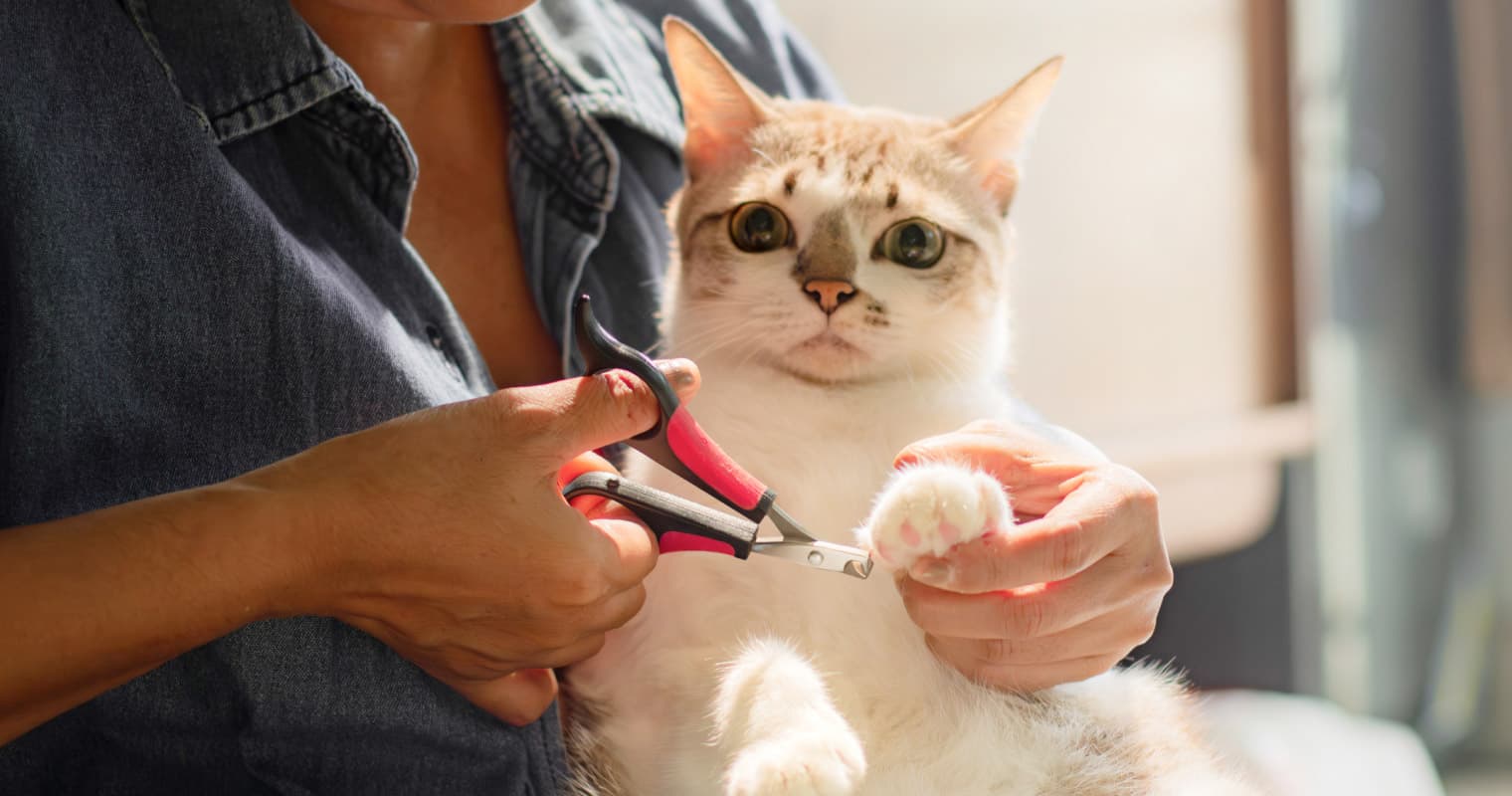
Before trimming your cat’s nails, you’ll need to get all the necessary tools: A cat or small-dog nail clipper. Human nail clippers can cause nail fracturing and be uncomfortable for your cat. You should also have high-reward treats, a towel, and styptic powder (aka something to stop the bleeding if you cut a nail too short) on hand. Quik-Stop is a common styptic powder brand available at pet stores, or you can grab some cornstarch, which works just as well.
Stage your area. Collect all your supplies and coax your cat over with their favorite treat or toy.
Assume the position. You can try sitting on the ground or standing at a table with your cat in front of you — usually their back to your front, aka facing away from you. If your cat doesn’t like to stay contained, you can try wrapping them in a towel and bundling them into your lap.
Pick your first paw. Front paws grow back quicker and cause the most issues, so you’ll likely want to start at the front. Try gently holding their paw and pushing on the paw pad to make the nail you want to cut stick out.
Cut the nail. When you make the cut, keep to the white/clear part of the nail tip. You’ll be able to see a pink section at the base of the nail which contains a nerve and blood vessels. This area is called the quick. You don’t want to cut into this part because it hurts and will cause your cat to bleed.
For cats who struggle with nail trims, it’s okay to do one paw each time or even one nail each time, and slowly work up. Heavy use of their favorite treats might encourage them to stick around longer and keep them from holding a grudge, so be sure to reward them throughout the process.
If you accidentally cut the quick, don’t panic. It only hurts for a second, and they will not bleed a dangerous amount from this injury. Try to apply the styptic powder to the tip of the nail to stop the bleeding if you can — then they should be OK.
It’s usually best to take a pinch of powder and press it to the cut edge of the nail. But you can also try pressing the whole paw into a container of powder for upset or wiggly kiddos.
Many cats don’t enjoy nail trims, and some won’t allow their parents to do it at all. The best thing you can do is start by acclimating your cat to having their paws handled and sitting still in your arms before you ever introduce clippers. When you do purchase nail clippers, leave them out in the home for your cat to sniff and get used to, so they don’t associate seeing them with needing to hide.
Cat wraps, bags, blankets, and towels are available to help contain a cat who won’t stay for a nail trim on their own. Asking for help from a second person can go a long way towards succeeding as well.
For cats who cannot safely go through any of the above, you can attempt a bit of DIY. You’ll need a scratching surface of your choice (board vs. pole), sheets of coarse-grit sandpaper, sisal rope, and some hot glue.
You can line the scratching surface with sandpaper, then wrap it with sisal rope more loosely than you usually see on scratching posts. Once that’s done, use catnip or toys to encourage your cat to explore it. The idea is to get them to scratch their nails against the sandpaper to wear them down and avoid the need for trimming. For help with a project like this and to learn how to teach your cat to use it, contact a local trainer who works with cats.
Another alternative is Soft Paws, which are caps that can be glued onto a cat’s nails to prevent damage to people and surfaces. They will need to have their nails clipped before placing these on them, so you’ll likely need help from a vet or groomer. But they can give you more time between nail trims and keep your cat’s paws looking extra cute.
If your cat simply cannot handle or tolerate a nail trim, then it’s time to ask for help. If you’re getting hurt or they are panicking, groomers or vet offices can step in for a safer, less stressful experience.
If your cat doesn’t handle travel well, remember there are housecall vets and in-home grooming services available, as well as medication your vet can give your cat for travel and stressful situations.
Declawing is a surgical procedure that involves amputating the end of a cat’s toe, removing the bone at the end of that toe — and the nail bed and nail along with it. This is a permanent change that alters how a cat can use their feet for the rest of their life and causes significant gait and arthritis complications as they age, no matter which specific procedure is used (laser vs. scalpel).
Cats who have been declawed suffer from increased anxiety, problems using the litter box, increased aggression and tendency to bite, early onset arthritis, inconsistent appetite, and sometimes develop chronic inflammatory conditions. For this reason, the procedure is banned in many places globally and within the U.S.
Luckily, trimming a cat’s nails is completely different. When you clip your cat’s nails through the white part of the nail, it’s painless, changes nothing permanently, and helps them interact with their environment more comfortably.
Although it’s possible to use human nail clippers in a pinch, they’re harder to use and cause more discomfort and nail damage for a cat. So it is recommended to use nail clippers designed for cats.
If you never trim a cat’s nails, it will be easier for them to damage furniture and clothes in your home, as well as accidentally scratch you. Additionally, they could break a nail or hurt themselves by getting a nail stuck in something. In certain cases, the nail can even grow into the paw pad and need treatment from a vet.
Start with rewarding your cat with treats or a toy for letting you touch them where they like to be pet. Then, work your way up to spending more time touching parts of their body they’re sensitive about, like their paws.
Outdoor cats will wear their nails down more than indoor cats, but they can still be prone to nails that grow into their paw pads as they age — so they may need their nails trimmed, too. Cats who roam outside might need their nails for protection, so consider their lifestyle before deciding to clip their nails.
You can start trimming a kitten’s nails as soon as they become sharp, sometimes as young as four weeks of age.
“Nail Trims in Kittens.” Veterinary Information Network, Cattle Dog Publishing, 15 Oct. 2021, www.vin.com/cattledog/default.aspx?pId=26671&id=10750999.
Nugen, Sarah, et al. “Desensitization and Counterconditioning to Nail Trimmers for Cats.” Veterinary Information Network, Veterinary Partner, 1 Dec. 2021, veterinarypartner.vin.com/default.aspx?pid=19239&id=10740673.
Schwarz, Katharine, et al. “Nail Trims for Adult Cats.” Veterinary Information Network, Cattle Dog Publishing, 2021, www.vin.com/cattledog/default.aspx?pId=26671&id=10741412.

Dr. Maria Zayas attended Ross University School of Veterinary Medicine where she completed her veterinary degree in addition to participating in and presenting research related to aquatic animal medicine. She spent her first year as a doctor working with a low cost spay/neuter and general practice clinic before returning to her home state of New York and entering the world of housecall veterinary medicine. Falling in love with this area of medicine, she launched her own housecall veterinary practice in addition to writing pet health articles. She loves all things related to water and continues to travel and explore with her three dogs and one cat, all of whom also love to swim.

Pet Wellness
Behavior & Training

Behavior & Training

Pet Wellness
What to expect from birth to 16 months.

Lifestyle
With great cuteness comes great responsibility. A vet breaks down everything you need to know when you bring home a new kitten.

Pet Wellness
From taking them to the vet more often to giving them a hand with grooming, older kitties need a little extra TLC.


Adoption Advice
From litter boxes to scratching posts, here’s how to shop smart before your new feline roommate moves in.
Pet Wellness
A cat veterinarian explains why the inhumane surgery is no joke.