My Dog Has Diarrhea but Is Acting Fine: What to Know
Understand their problem, and make an informed health decision.
Understand their problem, and make an informed health decision.
by Dr. Shelby Neely, DVM, | December 18, 2024
Pati Gagarin / Stocksy
If your dog suddenly has diarrhea, it can be alarming. Be aware, however, that veterinarians see many cases of diarrhea, most of which are not serious. It’s best to stay calm and evaluate the situation, which means assessing your dog and the poop. Does your dog have any other symptoms? Evaluate the appearance of the stool. If there’s no blood in their feces, repeated explosive watery diarrhea that could dehydrate them, or other symptoms, then it’s not an emergency.
This article will give you valuable information about diarrhea, its causes, home treatment, and when to call the vet.
Dogs have different types of diarrhea, including acute, chronic, and hemorrhagic.
Common causes of dog diarrhea include diet, food allergies or intolerances, stress, parasites, or infection.
If your dog has no other symptoms, you can try to treat it at home.
You need to see the vet if there are other symptoms, blood in the stool, or if it lasts longer than 24 to 48 hours.
Home care remedies include hydration, fasting, a bland diet, and probiotics.
It’s not fun for anyone.
Diarrhea can be acute or chronic. Acute means it has a sudden onset. Chronic diarrhea lasts longer, weeks or even months, and may have had a more gradual onset. Diarrhea can also be hemorrhagic (quite a bit of blood in the stool) or just very watery. There are additional ways to categorize diarrhea, but for our purposes, these will suffice.
Another way to categorize diarrhea in dogs is by cause. There are many causes of diarrhea, but the following are most common when no other symptoms exist.
Many dogs tend to have rather sensitive intestinal tracts. A morsel from your plate, a dive into the garbage can, or even a deliberate change of food can cause diarrhea in your pup. It’s important not to feed your dog people food and to keep garbage put away. It’s also critical to gradually change to a new food rather than doing it suddenly. These tips will help keep many potential cases of diarrhea away.
Food allergies involve the immune system and often cause ear or skin problems. They can come on gradually. An example of a food allergy is an immune reaction to proteins like chicken, beef, dairy, lamb, egg, fish, or soy. Less commonly, grains like wheat or corn can cause allergic reactions.
Food intolerance does not involve the immune system and occurs when a certain food causes digestive issues. A food intolerance reaction tends to occur right after eating the culprit food. An example of a food intolerance is when a dog is lactose intolerant.
We all know how stressed a dog can get. Changes in the environment, a new pet, separation anxiety, and loud noises can stress dogs. The reasons stress can cause diarrhea in dogs include:
Activation of the “fight or flight” mechanism leads to increased motility in the gut
The brain’s communication pathway to the intestines is disrupted
Decreased blood flow to the intestines
Behavioral factors such as over-eating
Parasites are a fairly common cause of diarrhea, especially in puppies. There are a few ways parasites in dogs can cause diarrhea, including by irritating the intestinal lining, disrupting nutrient absorption, triggering inflammation, and increasing water secretion in the intestines.
Bacteria (Salmonella, E. coli), viruses (parvovirus, distemper), and fungi are common enemies when it comes to infections and can also lead to diarrhea in dogs by damaging the intestinal lining, triggering inflammation, and disrupting normal digestion and water absorption.
It’s important to assess the severity of your pup’s diarrhea so you can decide whether to call or see your veterinarian.
Mild symptoms include loose stools without other issues. This type of diarrhea often resolves quickly with simple care. Serious symptoms involve blood in the stool, vomiting, lethargy, fever, dehydration, or diarrhea lasting more than 48 hours.
Mild diarrhea usually lasts one to two days. You will observe a slight increase in the frequency of your dog’s bowel movements. Severe diarrhea lasts longer (over 48 hours) and may involve very frequent bowel movements, often with other serious symptoms like blood, vomiting, or dehydration.
If your dog has diarrhea and develops accompanying symptoms, it’s time to go promptly to the vet. These symptoms include vomiting, blood in the stool, lethargy, fever, loss of appetite, dehydration, or weight loss. These symptoms may indicate a more serious underlying issue.
The short answer is no, but here’s why.
If your dog suddenly has diarrhea that isn’t bloody or accompanied by other symptoms, monitoring at home is usually fine. With simple home care remedies, your doggy will probably be okay in a few days.
However, monitoring for any change is urgent. If the diarrhea is getting worse instead of better, if it suddenly has blood in it, or if your dog develops other symptoms, it’s time to call your vet.
If your dog has diarrhea and develops any of the following, you should contact your veterinarian:
If diarrhea lasts for more than 48 hours. Your pup could get dehydrated, which could cause its own set of problems. Dehydration can be assessed by feeling the gums, which ordinarily should be moist, observing excessive panting, sunken eyes, or skin that doesn’t bounce back when pinched.
If you notice mucus or blood, either bright red or dark/black, in your dog’s stool, you could be dealing with a more serious problem.
If additional symptoms develop, such as vomiting, lethargy, fever, abdominal pain, bloating, or loss of appetite
If your dog’s diarrhea becomes extremely frequent or explosive
If your dog has underlying medical conditions like diabetes or thyroid disease, is immune compromised, and is on medications, even mild diarrhea should encourage you to contact the vet.
If there’s any chance your dog ate a foreign object or toxin, you should see the vet.
If you notice any unusual behavior
If your dog is a puppy, senior, or small-breed dog, you need to monitor them more closely.
If the diarrhea recurs
In summary, if your dog develops anything other than diarrhea, you should at least call your vet.
One of the first things to do if your dog has diarrhea but no other symptoms is to take up all food. This, of course, also means no treats, table scraps — nothing. A day without food will allow your dog’s intestinal tract to calm down and heal. However, you can and should leave down water.
If your pup starts begging for food, you must be tough and use toys, affection, walks, and play as distraction techniques. We know it’s hard to look at that face you love so much and not give in, but fasting for a short period is important so your pup will recover instead of worsening.
If no additional symptoms have appeared after 24 hours, you can proceed to the bland diet stage.
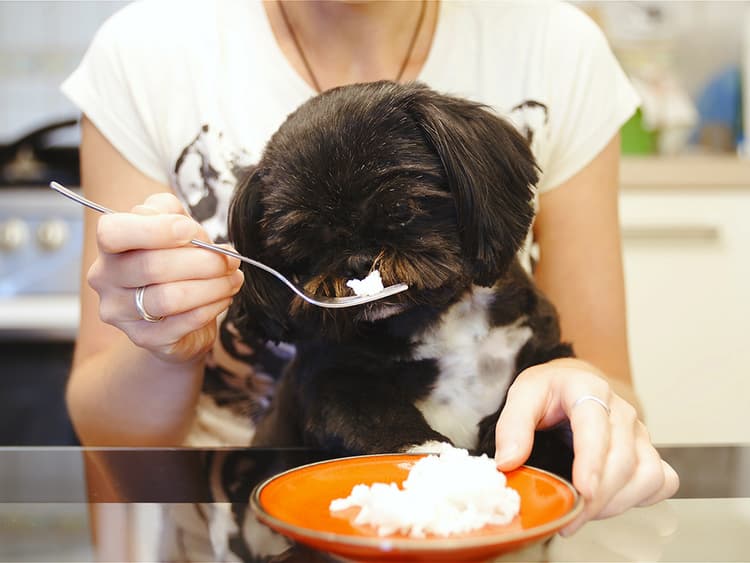
After 24 hours of fasting, do not return to your dog’s regular diet. First, you must feed your dog a bland diet until the diarrhea is completely resolved. What is a bland diet? Most people feed a diet of boiled chicken (no spices or gravy) and rice.
Make sure the chicken is boiled until fully cooked, then shred it into bite-sized pieces. Cook white rice according to package instructions, ensuring it’s soft and slightly overcooked for easy digestion. Mix one part chicken to two parts rice and allow the mixture to cool before serving.
Ground turkey and pumpkin can be substituted for the chicken and rice using one cup of ground turkey cooked in a skillet and drained well, half a cup of plain canned pumpkin, and one cup of white rice. Other substitutions include boiled eggs and rice, cottage cheese and mashed potatoes, or fish and sweet potatoes. However, most veterinarians recommend chicken or turkey.
Serve bland food in small, frequent meals (for example, two to three tablespoons every two to three hours for small dogs or half a cup to one cup for larger dogs). Gradually reintroduce your dog’s regular diet after two to three days if diarrhea improves.
Important Tips:
Avoid salt, seasonings, or oils
Always provide plenty of fresh water
Monitor your dog for any improvement or worsening of symptoms.
If symptoms persist for more than 48 hours or worsen, consult your veterinarian.
Diarrhea can dehydrate your dog if they are not eating and drinking. It’s essential to try and maintain good hydration. Pet parents often ask if Pedialyte is good for dogs. Most veterinarians agree that Pedialyte is not something to offer your dog. Definitely don’t give flavored Pedialyte. A bowl of fresh water is best. Refresh it frequently to make it more appealing. You can also try plain, unsalted bone broth or the water from the cooked rice.
Do not give any over-the-counter (OTC) remedies while your dog is fasting. Even when offering a bland diet, do not give anything except a probiotic and possibly a prebiotic. For dog diarrhea, use:
Probiotic: FortiFlora (contains beneficial bacteria to restore gut balance).
Prebiotic: Inulin or pumpkin (supports healthy gut bacteria growth).
You may be able to give over-the-counter medications if your vet approves.
Only give your dog Pepto Bismol with your veterinarian’s approval. Some dogs cannot have Pepto Bismol, so you need to check with your vet about your particular dog and the dose.
You should be aware and assess the situation as outlined in this article. There are some steps to take even if your dog is acting fine. See “home care remedies for diarrhea” above.
Your dog is probably not seriously ill; you can try home treatment.
Call your veterinarian if your dog has diarrhea for more than 24 to 48 hours, develops accompanying symptoms, or has blood in the stool.
Candellone, Alessia, et al. “Acute Diarrhea in Dogs: Current Management and Potential Role of Dietary Polyphenols Supplementation.” Antioxidants, vol. 9, no. 8, 9 Aug. 2020, p. 725, https://doi.org/10.3390/antiox9080725.
Gómez-Gallego, Carlos, et al. “A Canine-Specific Probiotic Product in Treating Acute or Intermittent Diarrhea in Dogs: A Double-Blind Placebo-Controlled Efficacy Study.” Veterinary Microbiology, vol. 197, Dec. 2016, pp. 122–128, https://doi.org/10.1016/j.vetmic.2016.11.015.
Rossi, Giacomo, et al. “Rapid Resolution of Large Bowel Diarrhea after the Administration of a Combination of a High-Fiber Diet and a Probiotic Mixture in 30 Dogs.” Veterinary Sciences, vol. 7, no. 1, 10 Feb. 2020, p. 21, https://doi.org/10.3390/vetsci7010021.
Stavisky, Jenny, et al. “A Case–Control Study of Pathogen and Lifestyle Risk Factors for Diarrhoea in Dogs.” Preventive Veterinary Medicine, vol. 99, no. 2-4, May 2011, pp. 185–192, https://doi.org/10.1016/j.prevetmed.2011.02.009.

Dr. Shelby Neely is a freelance writer and veterinarian who graduated from the University of Pennsylvania School of Veterinary Medicine and has practiced veterinary medicine for 30 years, specializing in small animals. Her work has appeared in Allivet, AsktheCatDoctor, WhiskerDocs, Ask the Cat Doctor Radio, Ask the Cat Doctor TV, and numerous other websites, brochures, newsletters, newspapers, and ebooks. In her spare time, Dr. Neely likes to spend time with her three children, two grandchildren, three cats, two grand-cats, and five grand-dogs.
Pet Wellness
Pet Wellness
Pet Wellness
Pet Wellness
It’s an alarming sight, but here’s what you should know.