How to Brush Your Dog’s Teeth
And other tips to make sure your dog’s teeth are as healthy as possible.
And other tips to make sure your dog’s teeth are as healthy as possible.
by Dr. Gabrielle Fadl, DVM, | January 9, 2025
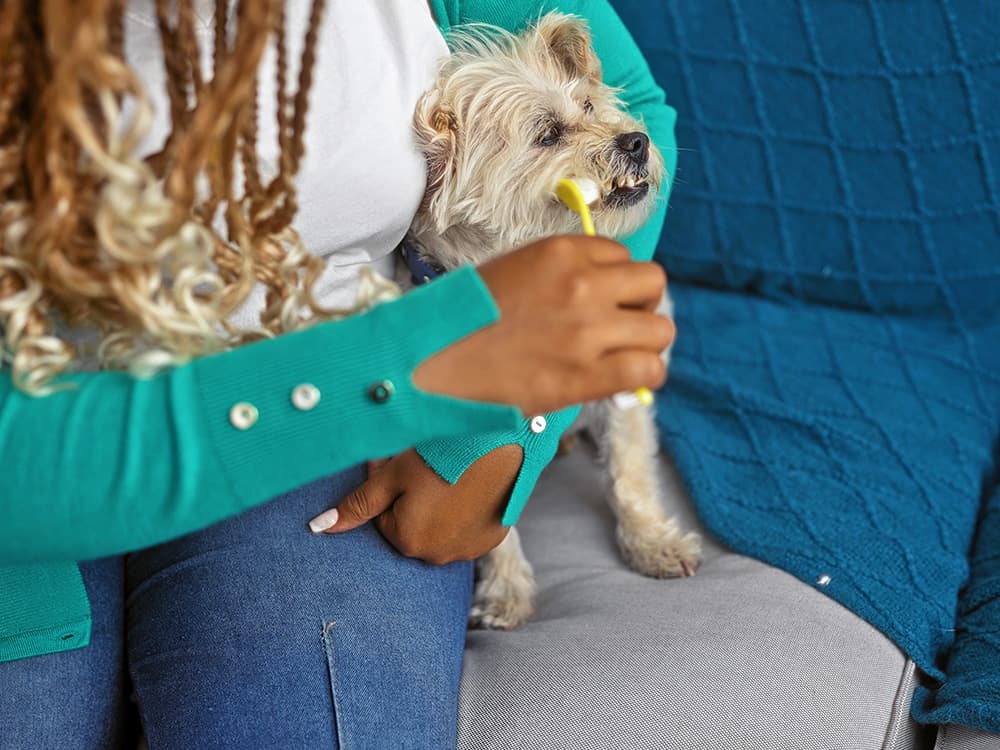
Krakenimages.com / Shutterstock
Periodontal disease is the most commonly diagnosed disease in small animal general practice. In fact, up to 85 percent of dogs over the age of three have some degree of periodontal disease, which will worsen in time if no treatment measures are taken. We are talking much more than just bad breath here: Advanced periodontal disease can lead to gum recession, tooth infection or abscesses, tooth loss, and oral discomfort for your pooch.
But it’s not all bad news. Although periodontal disease is so prevalent, it is also 100% preventable with a combination of good at-home care (including tooth brushing) and professional cleanings when the time is right. Read along to learn more about oral health in dogs and how we can keep it under control.
Neglecting your dog’s dental health can lead to plaque and tartar accumulation, bad breath, loose teeth, tooth loss, and oral pain.
Ideally, your dog’s teeth should be brushed daily.
Making brushing a part of your dog’s daily routine and rewarding progress with treats and positive reinforcement will make the process easier.
There is a misconception that dog saliva has antibacterial properties. This is simply not true. Plaque and tartar on a dog’s teeth are islands of bacteria. Brushing your dog’s teeth will not only help keep plaque and calculus at bay but will also prevent periodontal disease from progressing into more advanced stages.
What’s more, every time your dog licks your face – yup, you guessed it – all that bacteria is now on your skin, so brushing your dog’s teeth benefits you, too.
Periodontal disease is the most commonly diagnosed disease in small animal general practice. Daily brushing can help prevent periodontal disease from progressing to more advanced stages.
Neglecting your dog’s dental health can lead to plaque and tartar accumulation, bad breath, loose teeth, tooth loss, and oral pain. Periodontal disease is preventable with a good routine at home and in partnership with your veterinarian.
It is recommended to use veterinary-specific toothpaste and either a veterinary toothbrush or even a soft-bristled children’s toothbrush. These tend to be small and non-traumatic, and dogs seem to tolerate it better. Alternatively, there are finger toothbrushes that are made of a soft rubber that might be easier for some pet parents to maneuver in smaller mouths.
The Veterinary Oral Health Council also has a list of several products that can help keep your dog’s teeth clean and healthy, including toothpaste, water additives, dental chews, and more.
Keep in mind that the process of making tooth brushing a routine might be slow, but sticking to it will ensure that with time (and lots of treats and positive reinforcement), most dogs will become open to brushing. Some might even become excited about it.
The key is not to force it; at first, you might only be letting your dog smell or lick the toothbrush at first, or spend weeks brushing just one tooth. Before you know it, you will build your way up to brushing their entire mouth soon.
Here are some steps you can take to get started with brushing your dog’s teeth
Make sure you have a toothbrush – you can use a veterinary toothbrush, a finger toothbrush (which might be easier in some smaller mouths), or a children’s extra soft-bristled toothbrush from a pharmacy – and toothpaste specifically formulated for dogs, as human toothpaste can be harmful to your dog.
You can also prepare by determining the right time of day to brush your dog’s teeth. Pick a time that will be convenient for you each day and make it part of your daily routine.
Make sure your dog is comfortable, and try to make the experience as low-stress as possible. Take breaks frequently and reward good behavior often. If your dog smells or licks the toothbrush, reward them. If they let you touch the toothbrush to their tooth, reward them again. Try sitting with your dog in your lap or in a comfortable place, such as their bed or on the couch, while sitting next to them.
When you brush your dog’s teeth, you’ll want to focus on the spot where the tooth meets the gumline, as this is where plaque tends to accumulate most. Ensure you are not putting too much pressure on the gums, which may cause bleeding and discomfort.
Make sure to use a veterinary-labeled toothpaste. Some pet-formulated toothpastes are flavored to make the experience more tolerable.
It is best to brush a dog’s teeth with a soft or extra soft-bristled toothbrush.
Use small, circular motions and focus on brushing the outside surface of the teeth, as most dogs tend to tolerate this better than the inside, and plaque tends to accumulate there the most.
Remember, positive reinforcement will ensure brushing is a part of their regular routine and not a punishment.
Ideally, your dog’s teeth should be brushed daily. This will help keep plaque and tartar under control.
Brushing your dog’s teeth may be intimidating at first, especially if they aren’t used to it. However, making it part of their daily routine and rewarding progress with treats and positive reinforcement will make the process easier. It might take some time to work up to a full brushing, but persistence is key here!
No, it’s never too late to start brushing. In fact, making brushing part of your dog’s routine will prevent periodontal disease from progressing and prevent painful tooth loss or oral pain in the future.
Groomers will brush dogs’ teeth similarly to how pet parents do at home. However, this can be a stressful scenario for your dog if they aren’t used to having their teeth brushed regularly. Unfortunately, brushing once a month or less is not going to do a whole lot for your dog’s oral health; it really needs to be incorporated into their daily routine.
“How to Brush Your Dog’s Teeth - Veterinary Teaching Hospital.” Veterinary Teaching Hospital, 12 July 2023, vetmedbiosci.colostate.edu/vth/animal-health/how-to-brush-your-dogs-teeth/
Zawacki, Andrea. “How to Brush a Dog’s Teeth.” Carrington College, 27 Jan. 2016, carrington.edu/blog/how-to-brush-a-dogs-teeth/

After graduating from Kansas State University College of Veterinary Medicine, Dr. Fadl returned to the New York area to pursue a one-year rotating internship and has been working in general practice since. Dr. Fadl loves working in the pet space to foster the powerful human-animal bond. She hopes to continually learn and grow to practice the best quality medicine. Her motto is “Keep calm and try to take it as it comes.”
Pet Wellness
Pet Wellness
Pet Wellness

Pet Wellness
Understand the difference to take steps to eliminate them both.