How to Walk Your Cat on a Leash
Yes, cats can walk on a leash. Here’s our step-by-step guide for hitting the streets with your cat.
Yes, cats can walk on a leash. Here’s our step-by-step guide for hitting the streets with your cat.
by Avery Felman, | July 7, 2026
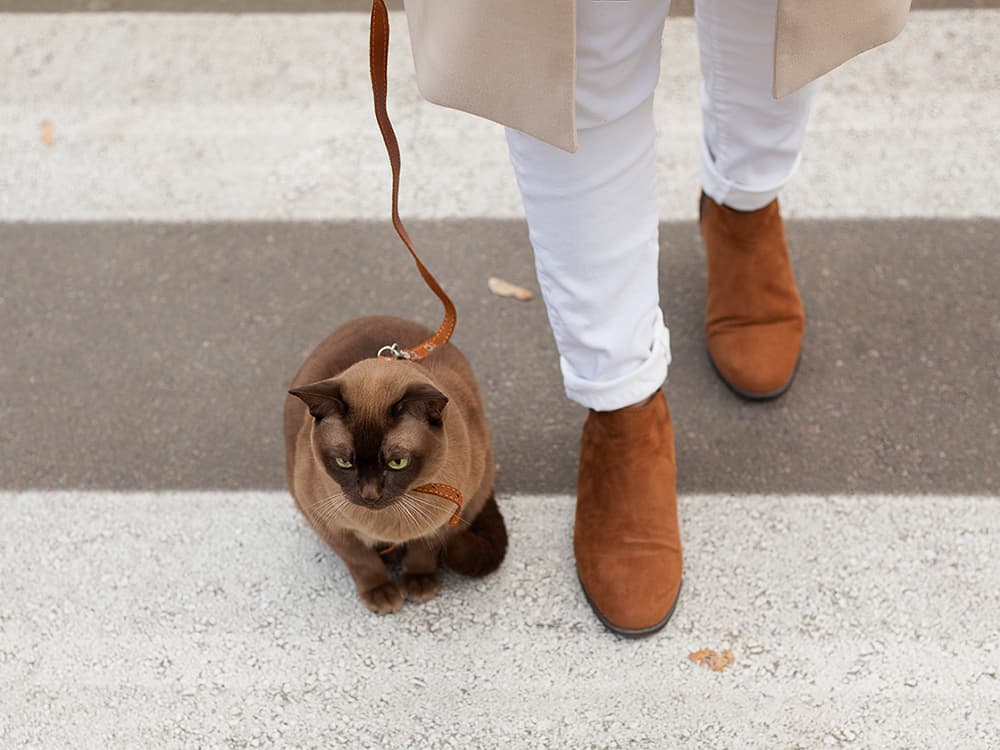
Klymenko Tetyana / Shutterstock
If your cat meows incessantly at the window or makes a run for it every time you enter or leave your house, you may have an aspiring adventure cat on your hands. Whether you want to indulge their curiosity in the outside world is completely up to you, but if you’re still reading, here’s how I safely harness-trained my cat for city life and the precautions cat expert and author of Adventure Cats: Living Nine Lives to the Fullest, Laura Moss, recommends you take.
Without the foresight that my cat may enjoy her little outdoors adventure so much that she’d be asking to shake up her environment again and again — almost always at 6 a.m. — I figured there’d be no downside to letting her roam the halls of my Brooklyn apartment building. That’s not to say I regret my choice to broaden her horizons. When her physical environment expanded, so did her mind.
The mental stimulation of trying to figure out how the front door opens (she now knows the doorknob has something to do with it) and smelling objects that go in and out of the apartment with us enriched her life in a way no other activity had. Her excitement, which she expressed through polite squeaks that turned into drawn-out, lyrical whines by 7 a.m., was well worth the planning the adventure required.
Throughout this process, I followed my cat’s lead and paid careful attention to her body language and limitations to ensure she was not only comfortable, but showing enthusiasm for the experience. Luckily, she initially expressed interest in venturing outdoors, so I didn’t have to assess whether I was projecting this newfound sense of adventure onto her.
Around the time she began freely running up and down the stairs of our apartment building and lingering by the double entryway doors, I knew she was ready to take the next step into the outside world. I also knew that I wanted to make the process as seamless as possible and that would require a bit of planning. Below, a step-by-step guide for taking your cat outside on a harness.
If your cat has already indicated that they want to explore more of the outside world, that’s great news. Otherwise, you’ll have to tread lightly and understand that all cats are different and may not enjoy the same things as others.
The best way to start this process is to see how they react when you open the front door: Do they run over or stay where they are? The former are known as “door-dashers,” according to Laura Moss, and should not be rewarded for this behavior lest they try to escape on a regular basis. “Every time you go out, carry your cat with you, just so your cat doesn’t get used to walking out on their own,” she advises.
Does your cat seem curious about the sounds coming from outside the apartment or frightened by them? It’s important to stay attuned to your cat’s behaviors and work off what you know about them (because after all, you know them best) to determine their level of security and comfort. “If you try to push it, you might damage your relationship with your cat or make them fearful, but I think cats are capable of so much more than we give them credit for,” Moss says.
The first thing to come to terms with: Walking a cat is not the same as walking a dog. Obviously. But we’re talking about the gear here. “Leashes attached to neck collars (or harnesses with attachments at the neck) are dangerous,” says Marilyn Krieger, the certified cat behavior consultant behind The Cat Coach. “The collar portion puts pressure on the front of the neck, which can cause serious injuries such as cutting off air supply. Also, they can strangle cats!”
Krieger isn’t a huge fan of walking cats, namely because exposure to dogs, commotion from people, and car traffic can cause stress. It’s important to make sure this is something your cat enjoys and never force them to go for a walk if it isn’t. The last thing you want is for your cat to writhe their way out of a harness and run off.
That said, “training a cat to wear a harness or walking jacket can come in handy if you have an emergency situation and need to move your kitty quickly and safely,” she says. And taking your cat for a walk provides exercise for both human and animal (and boredom relief for a frisky cat).
When fitting your cat for a harness, you will want to pay attention to the guides provided by each of the manufacturers you are considering. Each harness works and fits differently, but a common rule of thumb is that the harness should be snug but not constricting. In addition, harnesses should only be used on cats with a leash. Free-roaming outdoor cats should only ever wear breakaway collars that are designed to come off for a cat’s safety in case they get stuck on anything.
For more on how to get your cat used to wearing and walking with a harness, check out our guide here.
The best harness for your cat is the one that fits all of their needs. You should always make sure the measurements you take of your cat are accurate and that the harness slips onto your cat easily but is a snug enough fit so they don’t slip out of it. Our top overall picks from each category are:
Best escape-proof style: Sleepypod Martingale Calming Harness for Cats
Best brand for safety: Yizhi Miaow Tactical Cat Harness
Best harnesses with special features: Jackson Galaxy “The True Adventurer” Reflective Cat Harness and Leash Set
Best indoor harness: Found My Animal Prismatic Cotton Cat and Dog Harness
Laura Moss began speaking with behaviorists, veterinarians, and fellow pet parents to create a website for people who wanted to begin harness training their cat(s). The website, Adventure Cats, led to a book of the same title, as well as her second book, Indoor Cat: How to Enrich Their Lives and Expand Their World, which is coming out in April of this year. “I think there’s a tendency to think of cats that enjoy being outdoors, or Adventure Cats, as these very outgoing, fearless animals, but that’s not always the case,” Moss mentioned on our phone call.
“There are people who will rock climb with their cat. My cat’s huge adventure is going in the backyard, or we have a wildlife area not too far with ducks and beavers and that’s a huge adventure for them,” she says. “So, it’s just a matter of knowing what your cat is capable of and comfortable doing and also doing the training.” The training she mentions covers both harness and leash use, which are crucial steps in getting your cat off the couch and onto their next adventure. The adventure in question may be as simple as taking a whiff of outside air or exciting as climbing a tree at the local park.

A bored cat can develop everything from behavioral issues to physical ailments. Here’s how to keep your kitty mentally stimulated.
If your cat seems comfortable with the first step of the process, you can introduce them to the harness. Begin by leaving it somewhere close by, ensuring that they’re able to smell it and familiarize themselves with this new foreign object. If that seems to be going well, you can try opening and closing the velcro straps and buckles in front of them so they have a better awareness of the sounds they will hear when it’s fastened to their body. Then, try attaching and detaching the hardware of the leash and harness so they get used to the clinking sound it makes.
This may prove a bit difficult at first, considering that cats notoriously detest feeling constricted and don’t take to clothing as easily as dogs in most cases. However, if you can get your cat in the habit of wearing it for a few minutes per day — leaving it on a little longer every time and letting them walk around the house — it will improve their overall comfort when they’re in a new place wearing this odd contraption.
“I would put the harness by a food bowl or give him some treats so he would start getting those positive associations,” Moss says of introducing the harness to her six year old cat. “Once he was comfortable, we put the harness on and then immediately distracted him with a feathery stick or a favorite toy so that he would forget that he was wearing it.” Although it wasn’t as seamless an experience with harness training her older cat as it was her younger one, Moss offers advice to parents of cats of all ages. “It’s much easier to teach kittens because they’re so open to new experiences,” she says. “If your cat reacts negatively or they get scared, take the harness off, get them a treat, make it a positive experience.”

This popular training technique isn’t just for dogs. Here’s how you can use it for your cat.
The steps are getting more difficult with time, if you hadn’t picked up on that. While this step may seem like a no brainer, it was probably the one that my cat found most confusing and jarring. First, start by creating no tension between the leash and the harness. A cat who feels constricted or out of control of their movements will not be happy and may try to bolt. If they do make that attempt and are immediately jerked back by a taught leash, they will be even less happy.
You can remedy this by offering them a safe place to retreat to, like a , if they do get scared. Moss also recommends clicker-training and ensuring that your cat comes when you call their name. You should also be ready to canvas the area in the case of an emergency if your cat escapes or goes missing; Moss suggests “being prepared with recent photos of your cat on your phone, which I’m sure all cat people have.” She also notes some of the latest pet technology can be beneficial in these instances, including trackers that you can attach to their collars or micro-chipping your cat.
Once your cat is comfortable walking on a loose leash, you can attempt to guide them with a bit more of a restrictive lead, but in no circumstance should it feel like you’re dragging your cat around. If that’s the case, you should immediately abort the mission.

Some are sustainable, others are organic, but all are endorsed by discerning foodies (a.k.a. cats).
Well, the day has finally come for your cat to take the practical skills they’ve learned and studied so diligently and apply them in the real world. It’s almost like graduation. I have a feeling you two can take it from here, but just to reiterate, you should only take the next step when you’re confident that your cat is completely comfortable and demonstrates that they’re ready.
At this point, the world is their oyster. Take a stroll around the block, to your local park, or let them play in your urban jungle if you have any green space. Another wise piece of advice that Moss offers to cat parents seeking to raise an adventure cat: “You don’t have to take your cat outside of these epic adventures. It could be as much as opening a window or building a simple catio.”
Your outdoor cat may need to show some ID one day. Maybe they’re a tad capricious and are wont to stay out until all hours of the night (until you get a call from your neighbor). Or maybe there’s an organization doing good work rescuing cats in the neighborhood.
A collar with an ID tag signals that your cat already has a good home. But not just any collar will do. Cats are avid explorers that climb through bushes, over fences, and beyond. A traditional buckle collar can get snagged on something and become a choking hazard.
Breakaway collars — as the name suggests — breakaway or snap as soon as a collar is tugged at, so your cat can’t get caught. If you find this happens often, your cat’s microchip (they are microchipped, right?) ensures they find their way home.
Our top choice for an escape-proof harness is the Sleepypod Martingale Cat Harness. But if your cat is truly a flight risk, you may want to consider a backpack that keeps them safe and contained but still allows them a peek into the outside world.
Traveling or otherwise, harnesses should be selected based on your cat’s temperament and comfortability. And, when traveling with cats they should always be in a harness, rather than walking on a leash.
Harnesses should only be left on during training or when otherwise in use. Otherwise, you can fit your cat with a breakaway collar, which is a safer choice for their inside adventures because it won’t get stuck in any of their favorite hiding places.
All harnesses, regardless of the cat’s breed, should be selected based on the measurements provided by the manufacturer.

Avery is a writer and producer. She has written for numerous publications, including Refinery29, BuzzFeed, and V Magazine. When she’s not at her computer, you can find her reading, practicing her Greek on Duolingo, and delving into the Sex and the City discourse. She lives in Brooklyn, New York with her husband and their cat, Chicken, who rules with an iron fist.
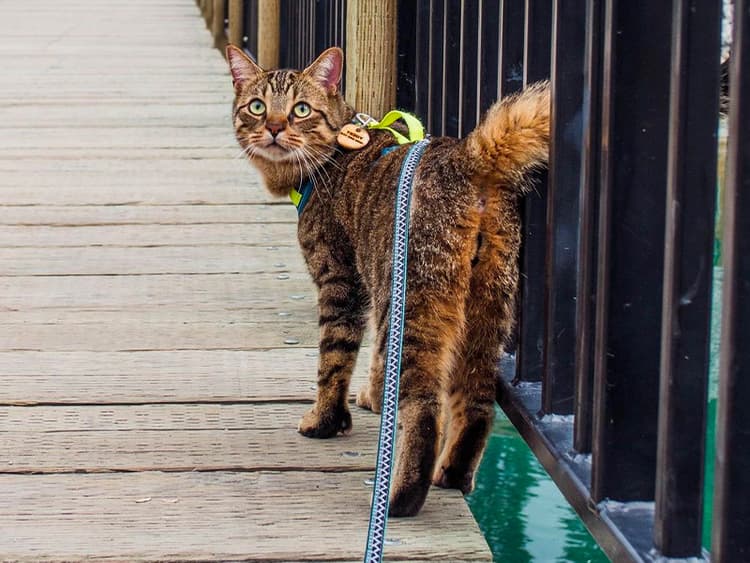
Lifestyle

Lifestyle
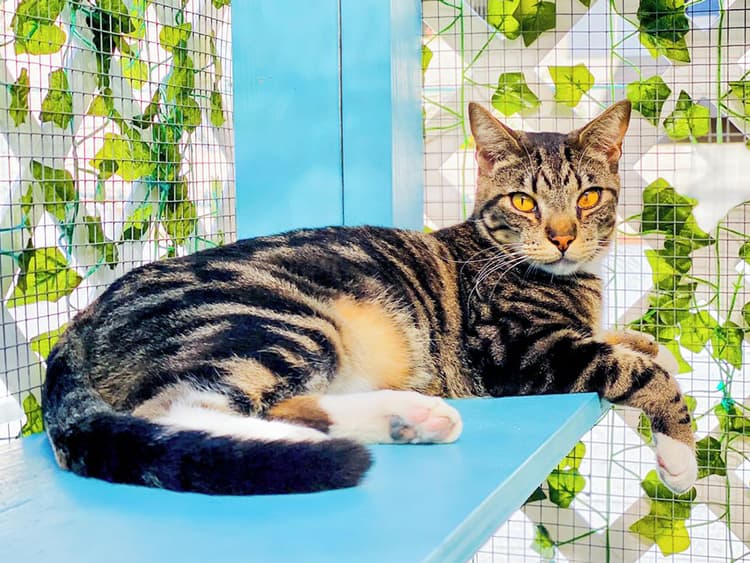
Lifestyle

Pet Wellness
Scoop cat poop early and often—and keep it away from your garden.