10 Signs Your Cat Has Imprinted on You
Feeling like you have a little shadow these days? Here’s why that’s happening.
Feeling like you have a little shadow these days? Here’s why that’s happening.
by Charles Manning, expert review by Cristin Tamburo, CFTBS, CAFTP | December 12, 2024
luke + mallory leisure / Stocksy
We’ve all seen videos of dogs reuniting with humans they haven’t seen in weeks (or even years) and going into absolute paroxysms of pleasure. But what about cats? They tend to be less demonstrably affectionate than dogs, but a cat’s imprinting instinct is still strong, says Los Angeles-based certified feline training and behavior specialist Cristin Tamburo (aka The Cat Counselor).
Recognizing whether your cat loves (or even likes) you is just a matter of knowing what to look for. Here are signs that your cat has imprinted on you, plus the reasons why they act so kooky sometimes (Hint: It’s often out of affection for you).
Cats can imprint on (develop strong attachments to ) their human caretakers through establishing trust.
Loud purring, grooming, and slow blinking are all signs that your cat has imprinted on you.
Show your cat they’re safe with you by respecting their boundaries and allowing them to approach you on their own terms.
Adobe Stock / DimaBerlin
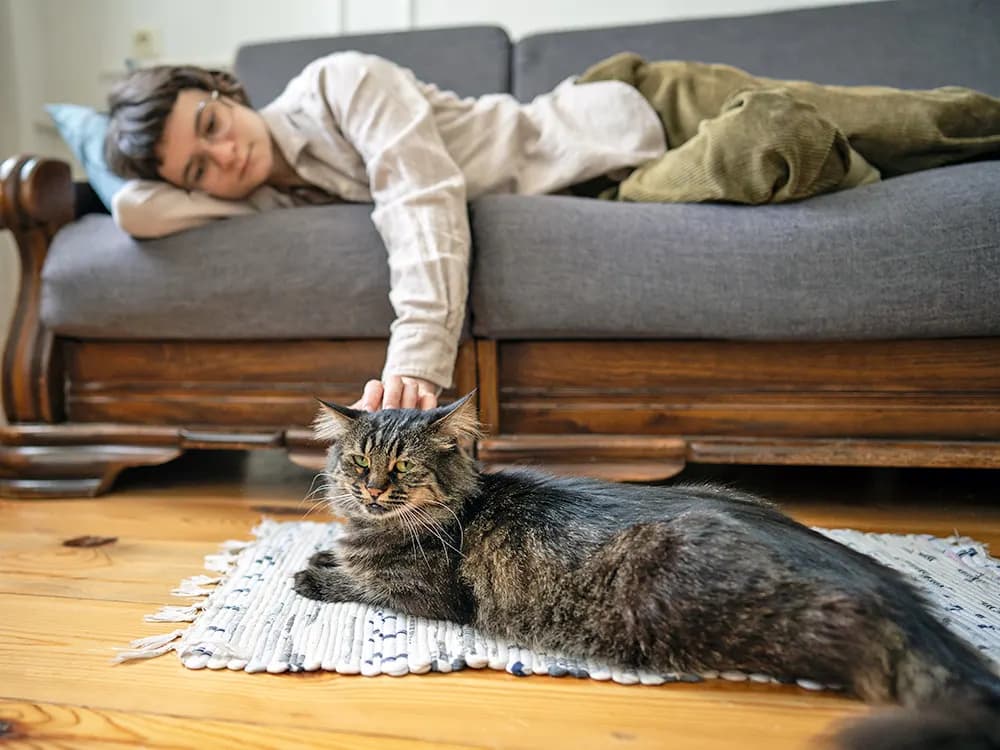
Cats tend to be independent creatures who prefer to live life by their own rules. However, they’re still capable of forming strong connections with their human caretakers. If you’re wondering how to get a shy cat to like you, the best thing you can do is let the cat take the lead. Pay attention to their body language and use slow movements and a gentle voice. Let the cat have the space they need and allow them to come to you when they’re ready.
Cat imprinting can mean several things, but typically it is defined by an establishment of trust. “Imprinting is something that happens during the sensitive, early development period of an animal’s life,” Tamburo says. “During this stage, an animal will (hopefully) build bonds or attachments — usually with their (cat) parents or the person who is taking care of them.”
Look for signs your cat has imprinted on you in their desire to be close to you, whether that means snuggling, sleeping in your bed, or just a general nearness. Your cat may also show affection by wanting to play with you.
Tatiana Timofeeva / Stocksy
“Why does my cat like to sleep on me? Why does my cat like to lay on me? Why does my cat like to lick me? Why does my cat purr so loud next to me?” The answers to many of these questions come back to imprinting. Cats communicate not just with vocalizations, but with their body language and attention, letting you know that they consider you part of their family.
When a cat has imprinted on you, there are several unmistakable signs of their deep attachment. First, they display an intense and consistent desire for your company. They may follow you around the house, sit near you, or seek physical contact, such as snuggling or kneading. Imprinted cats often exhibit a unique vocalization — a specific sound reserved for their chosen person, signaling their need for attention or companionship.
Additionally, they may display signs of distress or anxiety when separated from you for extended periods. Imprinted cats tend to be highly responsive to your voice, gestures, and facial expressions, and they may even mimic your behavior in subtle ways. Ultimately, their trust and comfort around you become evident through relaxed body language, purring, and slow blinking, which signifies a deep sense of contentment and security in your presence.
To sum up, your cat has imprinted on you if they:
Communicate with you by meowing, purring, or making other happy noises like chirps. Loud purring is often a way of expressing a sense of happiness and relaxation.
Knead on you (aka “making biscuits”). Kneading is an expression of comfort and safety that goes back to your cat’s kitten days; it’s the cat equivalent of sucking their thumb.
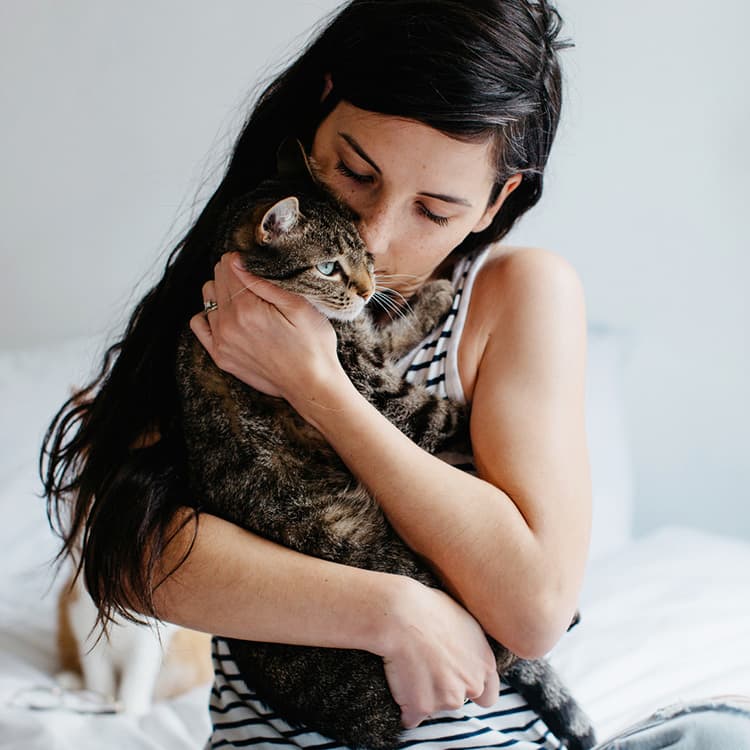
Want to be near you. They may follow you around, cuddle you, sleep with you, and want to be on your lap whenever they get the chance.
Greet you when you come home. Your cat may have missed your presence and is eager to say hello.
Rub on you, marking you with their scent. Cats head butt (or bunt) their human parents to put their scent on you, marking you as part of their group.
Enjoy playing with you and even instigating play. Cats generally only display play behaviors when they’re happy and relaxed.
Bring you “gifts” and go on “hunting” excursions for you. While the gift of a dead mouse may not exactly be welcome, it’s a way your cat expresses affection. They may also bring you things like socks, candy wrappers, or feathers.
Groom you. Cats often groom members of their family, so take it as a compliment, even though their tongues can be a little rough.
Slow blink at you. It might feel creepy, but your cat slow blinks at you because they trust you. Slow blinking is a sign that they are comfortable and relaxed in your presence.
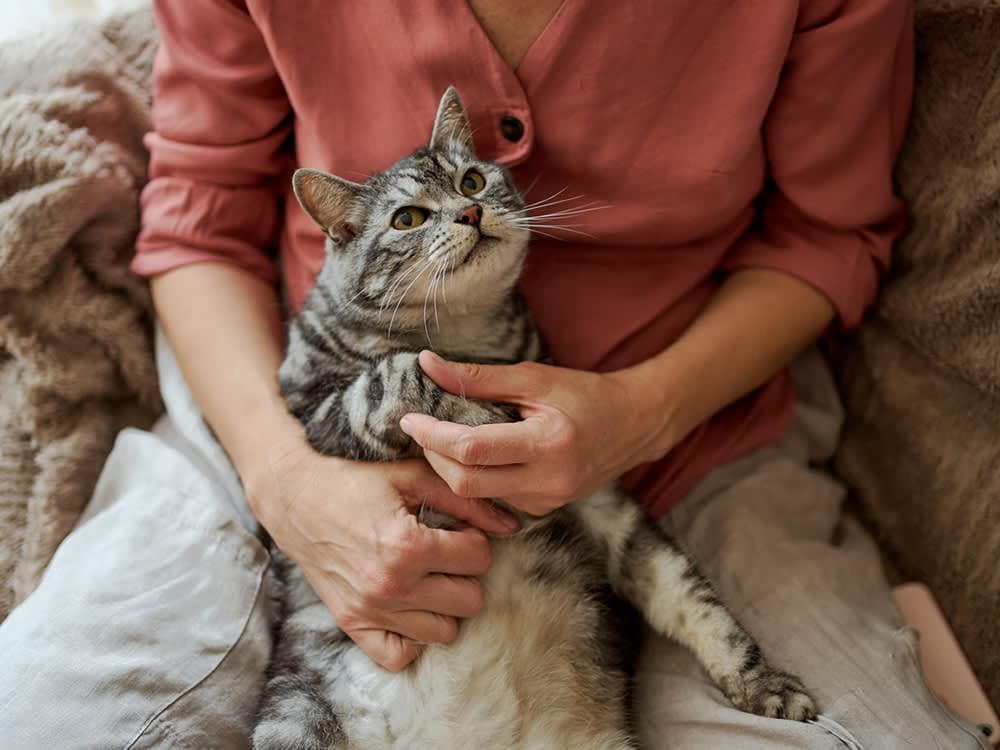
Display their trust by showing you their belly (although this may not be an invitation to touch said belly). If your cat shows you their belly, that means they feel comfortable around you.
“The initial imprinting stage for kittens tends to occur between two and seven weeks after birth,” Tamburo says. “Though a very short window in a cat’s relatively long life, the stimuli that they are and are not exposed to during this time can really shape their behavior and personality for the rest of their lives.”
After eight weeks, once a kitten has imprinted on their mother and littermates, the next stage of socialization begins — connecting with humans. “Additional socialization also occurs through their first four months, which is why, in the rescue world, we generally try to get kittens socialized and trusting humans by this four-month mark,” Tamburo says.
So, a person shouldn’t try to take a kitten away from their mother too early, in the hopes of getting them to imprint with them more strongly? “Kittens need and deserve time with their mothers and siblings,” Tamburo says. “It’s important for their overall development.”
Yes, older cats can imprint on you, although it may take a bit longer and manifest in different ways. Socialization after four months is still possible but can be more challenging. “Cats, like humans, imprint throughout their lives,” Tamburo says. “[Once] properly socialized, cats will often become imprinted on a human, even if they were not together during that early, sensitive period.” Older cats may be more likely to get attached to one person. “Often, this will occur with whichever human in the home provides the cat with the most care and attention,” Tamburo says.
Siamese, Ragdoll, Sphynx, and Maine Coon cat breeds tend to be needier and are more likely to imprint on a person. Some cats can be too attached to you. Separation anxiety can be a real issue for cats (just like for dogs), especially for those adopted during the pandemic, who got used to having their humans around all the time and now have to adjust to them spending more time out of the house.
Your next pet is out there — and we’re here to help you find them. Search adoptable pets from shelters and rescues, with the tools and support to guide you every step of the way.
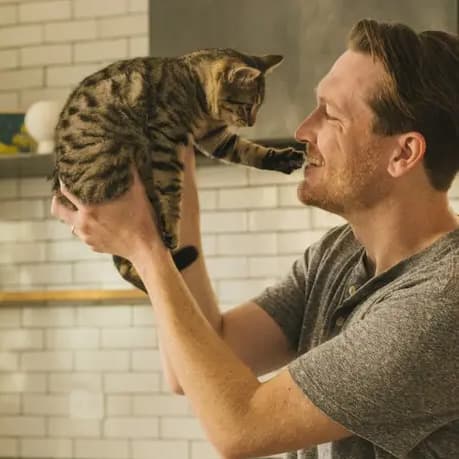
Cats don’t “fake affection” to get more food or be let outside, but they do use their body language to communicate their needs to you. Every cat is different, though, so how they express affection or demonstrate their bond with their person is different, too. But the desire to imprint — to connect and trust — is hardwired into cats (and humans). It’s a survival instinct.
“This is something we usually see in stray or feral cats, who may have missed their socialization period but still trust that one human who cares for them,” Tamburo says. “For instance, a colony of feral cats will likely run from most humans but will be excited to see the person who feeds them and cares for them. In some cases, they may show affection, but often they will accept the food and go back to their daily routine.”
While cats might not understand the concept of love, they do pick up on the affection you show them, your body language, and the care you provide them. All that love helps your cat build a strong bond with you. Even the grumpiest cats can sense the love and affection a person shows them; they just don’t always return it in a way that’s super obvious.
How do you get a cat to like you? Understanding how to read cat body language can help you determine your cat’s feelings for you — and help you figure out how best to show your love in return. While you can’t force your cat to imprint on you, you can strengthen your bond by providing them with time, attention, and affection. If you’re wondering how to get a cat to like you, consider these tips.
One of the best things you can do is mirror your cat’s body language while speaking softly and respecting their space. Avoid direct eye contact, which cats can interpret as intimidating. Instead, let your cat approach you and request pets before reaching out yourself.
Cats like to keep to a schedule, so try establishing a daily routine. If you have dinner and go to bed around the same times every night, your cat will likely feel more comfortable because they can predict what’s going to happen next.
You can even use positive reinforcement to help your cat develop positive associations with petting. Feed them treats while petting them to let them know that something good happens when they open up to contact.
You can tell your cat has imprinted on you when they communicate with happy meows and purrs, follow you around, sleep and cuddle with you, and show you their belly.
When a cat has imprinted on you, this means that they trust you and have a strong bond with you. They feel at ease with you because you make them feel safe, happy, and well cared for.
Cats form deep bonds with their humans and can get attached to one or more people depending on their history, personality, and socialization.
Yes, a cat trusts you if they sleep next to you. Sleeping, cuddling, and following you around are signs that a cat has formed a bond with you.
Generally speaking, cats do not like to be hugged or constrained. But each cat has their own personality and preferences, so some cats may enjoy being cuddled and hugged while others may prefer to be left alone.
Studies show that cats can actually become as attached to their pet parents as dogs — they just express their affection differently.
Baillie, Katherine. “Demystifying Feline Behavior.” Penn Today, 19. Feb. 220, penntoday.upenn.edu/news/demystifying-feline-behavior.
“Building a Trusting Relationship With Fearful Cats.” Metro Nashville Animal Care & Control, filetransfer.nashville.gov/portals/0/sitecontent/Health/PDFs/Animal/AdoptionResources/FearfulCats.pdf. Accessed 3 Dec. 2024.
“Cat Behavior Tips.” Regional Animal Services of King County, kingcounty.gov/~/media/depts/regional-animal-services/files/guides-for-pets/catbehaviortips_raskc.ashx?la=en. Accessed 3 Dec. 2024.
“Feline Adoption Packet.” DuPage County Animal Services, cms5.revize.com/revize/dupage/Animal%20Services/Documents/Adopting%20From%20DCAS/Cat%20Adoption%20Packet.pdf. Accessed 3 Dec. 2024.
Finka, Lauren R., et al. “Owner Personality and the Wellbeing of Their Cats Share Parallels With the Parent-Child relationship.” PLoS ONE, vol. 14, no. 2, Feb. 2019, p. E0211862. https://doi.org/10.1371/journal.pone.0211862.
Kucera, Tabitha. Types of Play for Cats: A Comprehensive Guide. 2020, www.montgomerycountymd.gov/animalservices/Resources/Files/Playingwithyourcat-2020.pdf.
Molier, Sarah-Jane. “Gentle Cat Love Bites: What Do They Mean? Feline Behavior Explained.” The Vets, 30 June 2024, thevets.com/blog/cat-love-bites.
Nagasawa, Takumi, et al. “The Urinary Hormonal State of Cats Associated With Social Interaction With Humans.” Frontiers in Veterinary Science, vol. 8, July 2021, https://doi.org/10.3389.fvets.2021.680843.
“Positive Reinforcement; Training Your Cat.” Oklahoma City Animal Welfare, www.okc.gov/home/showpublisheddocument/2074/635908683835430000. Accessed 3 Dec. 2024.
“Reducing Your Cat’s Fearful Behavior.” Oklahoma City Animal Welfare, www.okc.gov/home/showpublisheddocument/2088/635908684713870000. Accessed 3 Dec. 2024.
Rochlitz, Irene. “The Welfare of Cats.” Animal welfare, 2007, https://doi.org/10.1007/978-1-4020-3227-1.
Shreve, Kristyn R. Vitale, et al. “Social Interaction, Food, Scent or Toys? A Formal Assessment of Domestic Pet and Shelter Cat (Felis Silvestris Catus) Preferences.” Behavioural Processes, vol. 141, 2017, pp. 322-328, www.sciencedirect.com/science/article/pii/S0376635716303424, https://doi.org/10.1016/j.beproc.2017.03.016.
Taub, Benjamin. “Your Cat Knows When You’re Talking to It, New Research Suggests.” IFLScience, 25 Oct. 2022, www.iflscience.com/your-cat-knows-you-re-talking-to-it-but-just-doesn-t-care-65908.
Turner, Dennis C. “The Mechanics of Social Interactions Between Cats and Their Owners.” Frontiers in Veterinary Science, vol. 8, Mar. 2021, https://doi.org/10.3389.fvets.2021.650143.
Turner, Dennis C. “A Review of Over Three Decades of Research on Cat-Human and Human-Cat Interactions and Relationships.” Behavioural Processes, vol. 141, Aug. 2017, pp. 297-304, https://doi.org/10.1016/j.beproc.2017.01.008.
“Understanding Your Talkative Cat.” Oklahoma City Animal Welfare, www.okc.gov/home/showpublisheddocument/2100/635908685530930000. Accessed 3 Dec. 2024.
“Why and How Do Cats Purr?” The Library of Congress, 2015, www.loc.gov/everyday-mysteries/browse-all-questions/item/why-and-how-do-cats-purr/. Accessed 3 Dec. 2024.
“Why Do Cats Rub Their Cheeks on Stuff?” Ask Dr. Universe, 9 Nov. 2023, askdruniverse.wsu.edu/2023/11/09/7411.

Charles Manning is an actor and writer based in New York City. In his free time he likes to cook, go swimming at the public pool, volunteer at the LGBTQ senior center, and foster senior and special-needs cats. His work has previously appeared in Cosmopolitan, Elle, Marie Claire, Harper’s Bazaar, Seventeen, and Nylon.
Behavior & Training
Behavior & Training
Behavior & Training
Behavior & Training
Not into cuddling? Too bad—they’re spending the night.
Behavior & Training
Tips to help you find a legit behaviorist (according to a veterinary behaviorist).